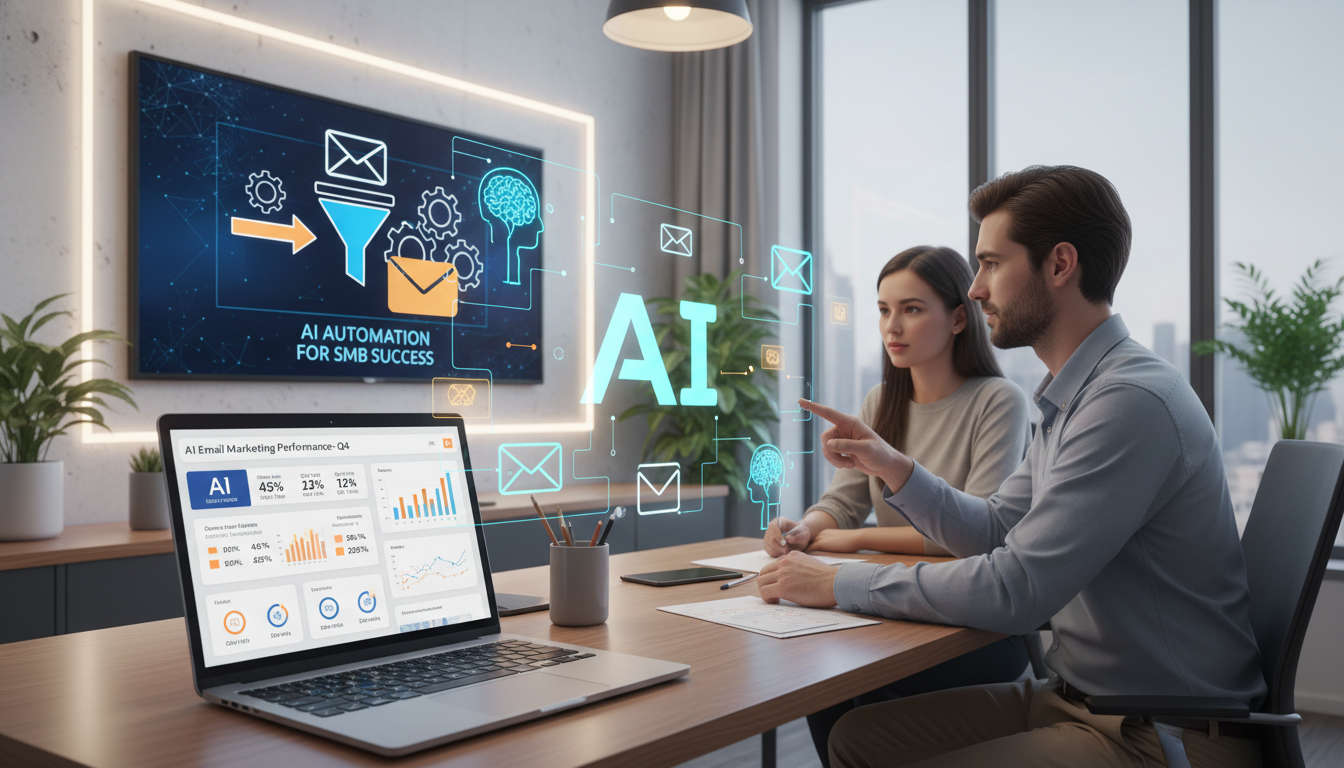
Why Email Marketing Remains Essential for Business Growth
Email marketing continues to deliver exceptional returns for small businesses despite the explosive growth of social media platforms. Furthermore, the statistics speak volumes: email generates 30-40x return on investment, making it one of the most cost-effective marketing channels available. Interestingly, automated emails produce 37-41% of email-driven sales despite representing only 2% of overall email volume, demonstrating the power of strategic automation.
Consequently, the case for email marketing strengthens when examining automation metrics. Automated campaigns achieve 52% higher open rates and 332% higher click rates compared to non-automated campaigns – a staggering difference that reveals why email marketing automation deserves priority investment. Moreover, email provides direct access to customers without algorithm interference, enabling precise targeting through segmentation that social media platforms simply cannot match.
For SMBs specifically, email offers a critical competitive advantage. Whilst larger enterprises invest millions in paid advertising and maintain dedicated marketing teams, small businesses can leverage AI email marketing automation to build lasting customer relationships cost-effectively. Additionally, this channel complements social media and content marketing perfectly, creating a comprehensive strategy. The fundamental difference between traditional email campaigns and modern AI-powered automation lies in continuous, 24/7 nurturing of prospects without manual intervention – something impossible at scale with human effort alone.
The Limitations of Manual Email Management for Growing Teams
Manual email management creates substantial operational challenges for growing SMBs facing resource constraints. Time-consuming repetitive tasks including list segmentation, campaign scheduling, and performance analysis consume hours that could fuel strategic growth. Consequently, manual processes severely limit scalability, introduce human error, and require deploying valuable team members to routine tasks rather than innovation.
Moreover, manual email workflows prevent real-time personalisation and customer journey optimisation. SMBs struggle identifying optimal send times for different customer segments, adapting campaigns based on behaviour patterns, and conducting meaningful A/B testing – all labour-intensive activities. Furthermore, these limitations prevent small businesses from competing effectively with larger companies boasting dedicated marketing teams. The opportunity cost becomes devastating: teams deploy resources to routine email tasks when they could focus on product development, customer service, or strategic initiatives.
Resource constraints force many SMBs to abandon email marketing altogether, leaving substantial revenue on the table. This scenario makes AI-powered email automation workflows not merely advantageous but essential for competitive survival. Additionally, businesses attempting manual email management often experience list fatigue, poor segmentation, and declining engagement metrics, creating a downward spiral. Therefore, embracing automated solutions transforms what was previously an unsustainable burden into a revenue-generating engine.
How AI Transforms Email Marketing Operations
Artificial intelligence revolutionises email marketing through capabilities that were previously impossible at scale. Intelligent email segmentation uses machine learning to automatically categorise customers based on behaviour, demographics, purchase history, and engagement patterns. Consequently, instead of manually dividing audiences into broad categories, AI identifies micro-segments revealing hidden high-value audiences.
Furthermore, AI generates personalised subject lines and email content that resonates with individual segments, dramatically improving engagement metrics. Dynamic content blocks adjust messaging based on recipient data, ensuring relevance and preventing the generic, one-size-fits-all approach that plagues traditional campaigns. Additionally, predictive send-time optimisation determines when each recipient is most likely to engage – eliminating guesswork entirely. This technology increases open rates by understanding each person’s email-checking behaviour.

Moreover, behaviour-triggered campaigns respond automatically to customer actions such as abandoned carts, website visits, or email engagement patterns. AI analyses campaign performance in real-time, identifying what works and continuously optimising future campaigns. Consequently, these AI capabilities work together seamlessly to create personalised customer journeys at scale without manual intervention. SMBs now deliver enterprise-level marketing experiences through email automation AI that would previously require enormous budgets and staff.
Practical Email Automation Workflows for SMBs
Concrete automation workflows deliver immediate business impact for small businesses ready to embrace AI email sequences. Welcome series automations nurture new subscribers through progressive value delivery over multiple touchpoints, establishing positive first impressions. Furthermore, abandoned cart recovery campaigns automatically re-engage customers who left without purchasing, including AI-generated product recommendations and dynamic pricing personalised to each shopper.
Consequently, win-back campaigns reactivate dormant customers using AI-identified ideal re-engagement timing, whilst post-purchase follow-up sequences gather feedback, encourage reviews, and recommend complementary products. Additionally, lead nurturing workflows move prospects through the sales funnel with progressively more targeted messaging based on their engagement level. SMBs can implement no-code email campaigns without technical expertise through intuitive platforms designed for non-technical teams.
Moreover, upsell and cross-sell automations trigger based on purchase history and browsing behaviour, identifying optimal moments for expansion revenue. The implementation roadmap suggests starting simple with one automation and progressively adding complexity as team confidence grows. Furthermore, AI handles execution whilst SMBs focus on strategy and overall business objectives, fundamentally changing how marketing departments operate. This approach enables lean teams to punch above their weight against larger competitors with bloated organisations.
Integrating Email Automation with Shopify and WordPress
SMBs can seamlessly integrate AI email automation with existing Shopify stores and WordPress websites, creating unified marketing ecosystems. Shopify AI email marketing enables automatic customer data syncing, real-time product catalogue updates for recommendations, and trigger-based emails from customer actions within the store. Consequently, every purchase, browse session, or abandoned cart automatically initiates relevant follow-up campaigns.
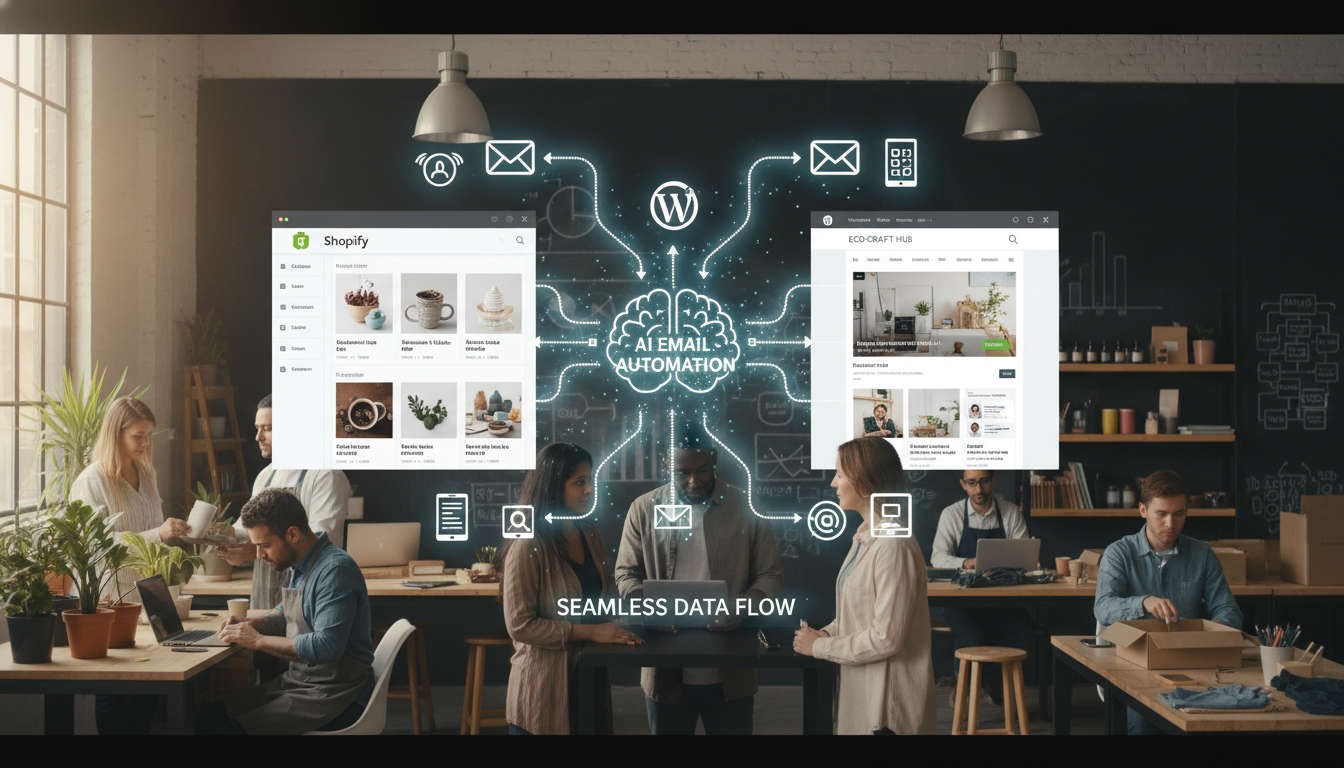
Furthermore, WordPress AI email marketing integration captures email subscribers from website forms, triggers emails based on content engagement or downloads, and enables blog-based lead magnets with automated follow-up sequences. Additionally, these integrations enable zero-friction customer journeys where prospects move seamlessly from discovery through purchase to retention. Learn more about AI email marketing for Shopify and WordPress to understand seamless integration strategies.
Integrated systems provide complete views of customer behaviour across all channels, enabling sophisticated segmentation and personalisation impossible with disconnected platforms. Moreover, this approach eliminates manual data entry, ensures campaign accuracy, and maintains data privacy through automatic GDPR, CASL, and CAN-SPAM compliance. Step-by-step guidance through no-code setup makes integration accessible to all SMBs regardless of technical expertise, democratising enterprise-level sophistication.
Measuring Success with AI-Driven Email Analytics
AI email campaign management provides actionable insights extending far beyond basic metrics like open and click rates. Predictive analytics forecast campaign performance before sending, enabling proactive optimisation before resources commit. Furthermore, AI calculates customer lifetime value to identify high-value subscribers worthy of premium content and VIP treatment.
Consequently, churn prediction identifies at-risk customers before disengagement, enabling targeted re-engagement campaigns that salvage relationships. Additionally, AI attribution tracks true revenue impact by connecting email interactions to actual purchases and customer loyalty, replacing guesswork with data-driven confidence. Engagement scoring ranks subscribers by conversion likelihood, enabling resource concentration on highest-potential prospects.
Moreover, AI identifies optimal send times, subject line characteristics, and content themes driving performance for specific segments. Automated A/B testing continuously experiments with different approaches and scales winners across campaigns. Furthermore, real-time dashboards display key metrics enabling quick decision-making and iterative improvement. Each campaign informs the next through continuous learning cycles, positioning SMBs to outcompete rivals through smarter decision-making and data-driven optimisation rather than intuition alone.
Overcoming Common Implementation Challenges
Practical obstacles emerge when SMBs implement AI-driven email automation, yet solutions exist for each challenge. Data quality issues including incomplete customer records or poor list hygiene respond well to AI cleaning and standardisation processes. Furthermore, concerns about personalisation at scale and template complexity dissolve when modern no-code platforms make sophisticated campaigns simple for non-technical teams.
Consequently, email deliverability concerns about sender reputation, authentication, and sending patterns resolve through platform management of technical requirements. Additionally, compliance worries regarding GDPR and data consent requirements ease when automation platforms handle these automatically. Adoption resistance from team members unfamiliar with automation decreases through proper training and change management emphasising benefits and quick wins.
Moreover, brand voice concerns about robotic-sounding emails diminish when AI-generated content follows established brand guidelines and tone settings. Integration complexity with existing systems becomes manageable through straightforward APIs and plugins requiring minimal technical effort. Realistic timelines show quick wins within days and full programme maturity within weeks. Furthermore, troubleshooting common issues such as poor open rates or list fatigue receives structured support through platform analytics. Embracing no-code email automation guides positions SMBs for significant competitive advantage once obstacles clear.
Maximising Revenue Impact Through Sophisticated Segmentation
Intelligent audience segmentation enables delivering the right message to the right person at the right time, dramatically improving revenue. Email segmentation AI enables granular division based on purchase history, browsing behaviour, engagement levels, geographic location, customer lifecycle stage, and predicted conversion likelihood. Consequently, AI identifies hidden patterns in customer data that humans would miss.
Furthermore, behaviour-based segmentation continuously updates as customers interact with emails and websites, ensuring relevance persists over time. RFM (recency, frequency, monetary) analysis identifies best customers for VIP treatment and at-risk customers needing retention efforts. Additionally, dynamic segmentation automatically moves customers between segments based on changing behaviour patterns and purchase trajectories.
Moreover, sophisticated segmentation enables message customisation, offer optimisation, and channel selection for each segment uniquely. Specific examples include offering new products to engaged customers, clearance items to inactive segments, and loyalty incentives to repeat buyers. Consequently, this approach increases conversion rates and customer lifetime value whilst reducing unsubscribe rates and spam complaints. Furthermore, segmentation eliminates wasted spend sending irrelevant messages to uninterested recipients, maximising budget efficiency. SMBs transform email from broadcast communication to precision targeting, fundamentally improving marketing effectiveness.
Building Long-Term Customer Relationships Through Progressive Nurturing
AI email automation enables building deep, lasting relationships through strategic progressive nurturing rather than transactional blast emails. The customer lifecycle journey progresses from awareness through consideration, purchase, loyalty, and advocacy – each stage requiring different messaging and offers. Furthermore, different segments require tailored approaches based on their stage and history with your brand.
Consequently, progressive profiling gradually collects customer information over time through interactive elements rather than intimidating long forms. AI identifies optimal timing for moving customers to the next lifecycle stage, preventing premature sales pushes or delayed follow-up. Additionally, content marketing approaches educate prospects through valuable insights before requesting sales commitments, building trust and credibility.
Moreover, social proof, case studies, and testimonials automatically deliver to prospects considering purchase, addressing objections systematically. Post-purchase nurturing ensures customer satisfaction and creates repeat buyers through consistent communication and value delivery. Furthermore, loyalty programme integration rewards customers for engagement and purchases, creating advocates who generate referrals. Regular communication maintains top-of-mind awareness especially during long consideration periods when customers might otherwise forget your brand. Personalisation at each stage makes customers feel valued rather than manipulated, building genuine relationships. Finally, consistent, relevant nurturing converts prospects to customers, customers to repeat buyers, and buyers to advocates – creating sustainable competitive advantage through customer satisfaction and lifetime value maximisation.