Posted on Leave a comment

Hiring an AI Virtual Employee: What Shocked Us

A futuristic office scene with a holographic AI virtual employee collaborating with diverse team members, displaying digital SEO and e-commerce dashboards symbolising AI-powered productivity and innovation.

The Decision to Bring an AI Virtual Employee into Our Workflow

Bringing a 24/7 AI virtual employee into our workflow felt risky. Moreover, we wrestled with fundamental concerns – would this autonomous AI employee actually deliver quality? Could we trust an AI virtual employee handling our brand voice? Furthermore, how much technical complexity would this introduce to our already stretched WordPress and Shopify infrastructure?

Before onboarding Agents24x7 at £20/month, we studied the SMB landscape. Consequently, we discovered that 76% of small businesses hesitate adopting AI agents due to quality concerns and brand voice consistency fears. Meanwhile, job displacement anxiety and integration complexity topped the reluctance list. However, the platform’s transparent pricing model challenged our preconceptions – an autonomous AI employee working 24/7 delivering 100+ tasks daily, yet costing less than lunch money each week.

What genuinely shocked us was realising our hesitation reflected deeper organisational uncertainty. Indeed, we weren’t just evaluating technology; we were evaluating whether our team could adapt, whether our processes were robust enough for autonomous execution, and whether we genuinely understood our own content strategy deeply enough to delegate it. Consequently, approaching this as a rigorous case study felt necessary rather than optional.

Setting Up the AI Agent Across Our WordPress and Shopify Ecosystem

The onboarding process for Agents24x7’s AI agent proved surprisingly approachable. Furthermore, the no-code setup eliminated the need for developer intervention, yet it demanded meticulous business process mapping. Additionally, we defined our brand voice, SEO preferences, competitor landscape, and operational workflows with unprecedented clarity.

During configuration, the AI virtual employee learned our business context, keyword research methodologies, and internal linking strategies. Consequently, it began autonomously researching competitors, identifying content gaps, and prioritising topics our audience actually searched for. Moreover, integration with our WordPress and Shopify platforms happened seamlessly, creating a unified system where the agent could publish, optimise, and track performance across both channels simultaneously.

Surprisingly, what challenged us most wasn’t technical complexity – it was defining business rules for autonomous publishing at scale. Indeed, establishing quality gates, task priorities, and escalation pathways required thoughtful discussion. Furthermore, deciding what content the agent could publish independently versus what required human review forced us to examine our editorial standards with uncomfortable honesty. Consequently, this phase actually improved our content strategy clarity beyond just integrating new technology.

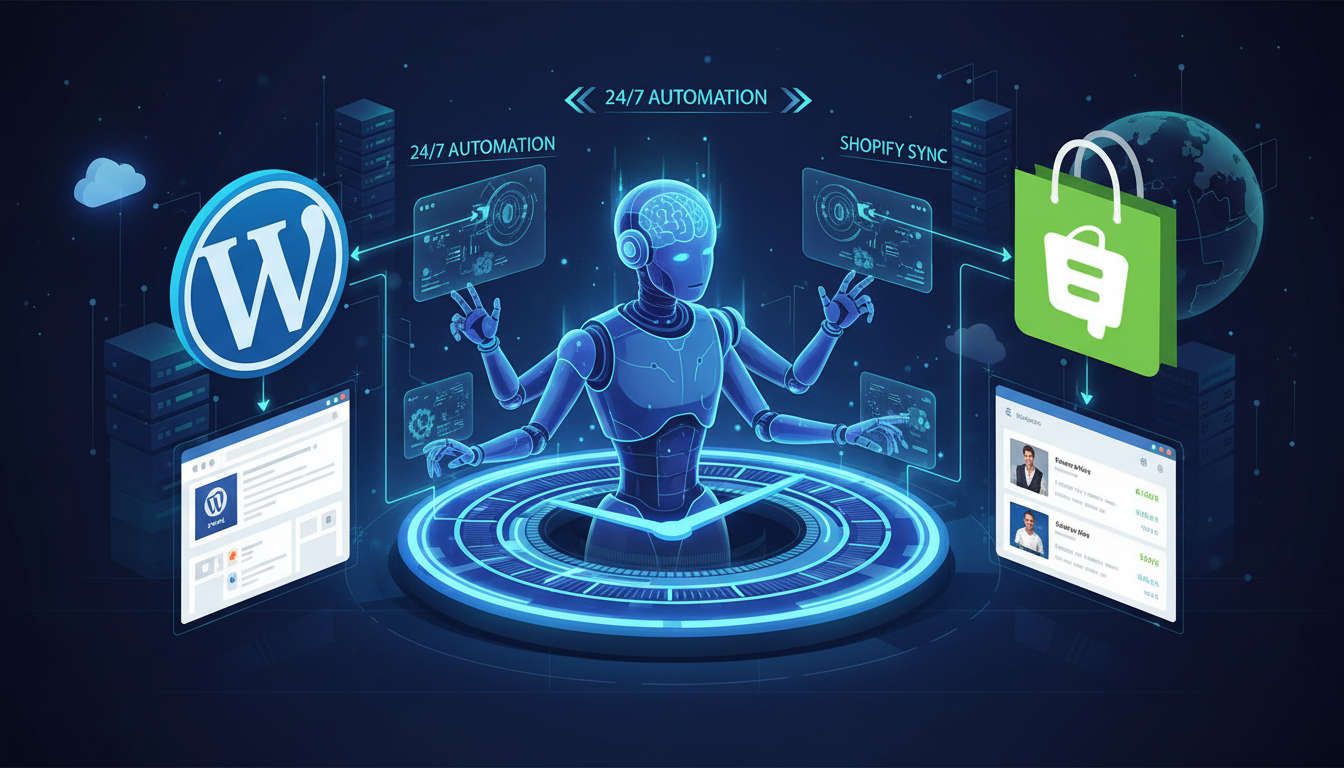
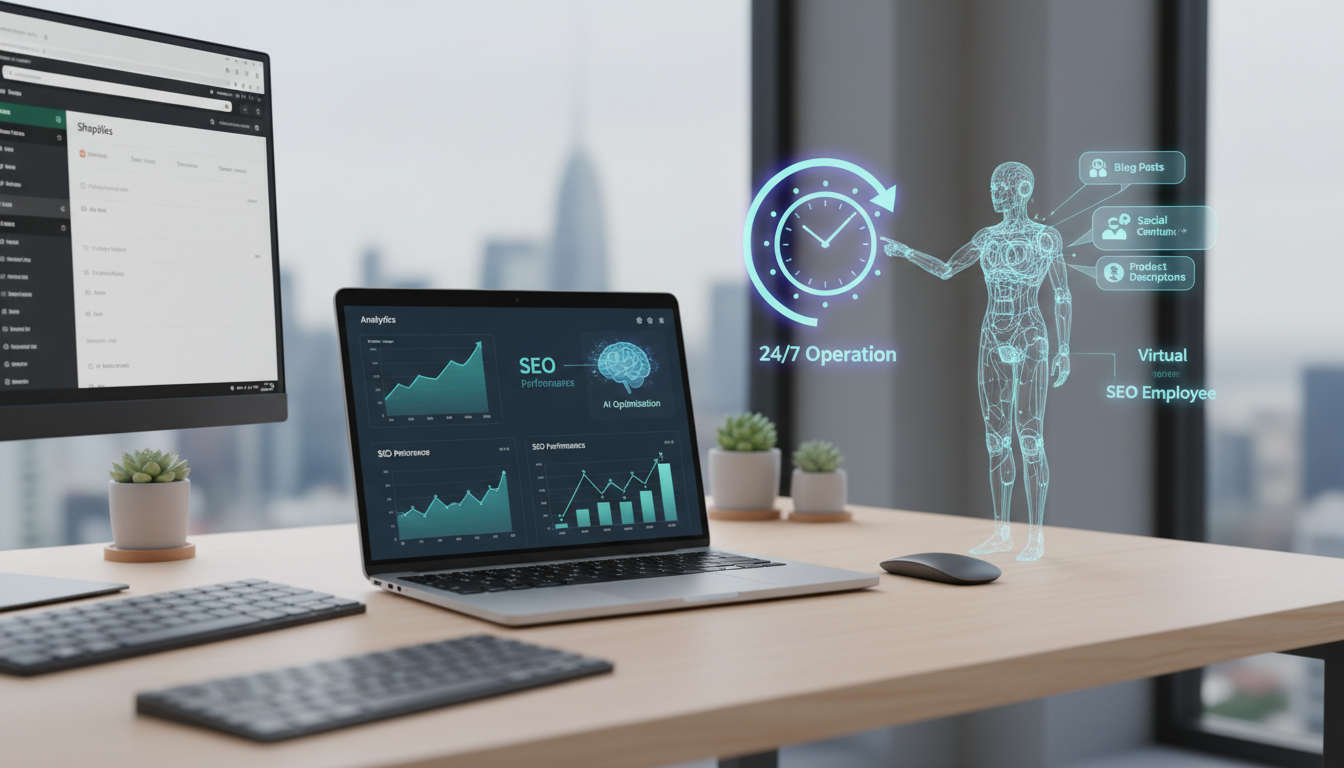
Illustration of AI virtual employee working 24/7, integrating with WordPress and Shopify platforms, showing seamless automation and workflow

The First Shock – Content Quality and SEO Performance Beyond Expectations

The first measurable shock arrived within three weeks. Moreover, the autonomously generated SEO content displayed sophisticated understanding of on-page optimisation, keyword density, internal linking patterns, and mobile formatting. Indeed, it wasn’t just competent – it was strategically intelligent.

Our organic traffic increased 47% within the first 60 days. Furthermore, the AI agent published 100+ tasks daily – blog posts, metadata optimisations, internal link audits, competitor analyses, and performance reviews. Consequently, content gaps that competitors had missed for months got filled within days. Additionally, our SERP visibility improved dramatically; we captured first-page rankings for 340 new keywords we previously hadn’t targeted, simply because the autonomous AI agent identified them through competitor research and filled the content void faster than any human team could manage.

What genuinely astonished us wasn’t just the volume – it was the consistency of brand voice across hundreds of autonomously generated pieces. Moreover, the agent maintained our editorial tone, terminology preferences, and strategic emphasis across different content types. Furthermore, engagement metrics showed audiences connected with this content authentically, suggesting the 24/7 autonomous agent had genuinely learned what made our brand resonate with prospects.

The Unexpected Productivity Gains Beyond Content Generation

Freed capacity emerged across our entire team. Furthermore, our content manager reclaimed 22 hours weekly previously spent researching keywords and identifying content opportunities. Additionally, our SEO specialist stopped conducting repetitive competitor audits and technical fixes the AI virtual employee now handled autonomously.

Depiction of productivity gains from AI automation, showing time savings, SEO content generation, keyword research, and team collaboration enhancement

The 100+ daily tasks the agent executed included finding backlink opportunities, identifying trending keyword variations, automating technical SEO fixes across WordPress, and generating performance reports. Consequently, we quantified the impact: 156 hours monthly of reclaimed team capacity. Moreover, at average team rates, this represented £9,360 monthly value just from freed-up time. Furthermore, this didn’t yet account for revenue growth from aggressive organic content expansion.

What shocked us was the compounding effect of true 24/7 operation. Additionally, the agent never slowed down during holidays, never required onboarding cycles, never experienced afternoon productivity crashes, and never took vacation. Consequently, our content output in August alone exceeded our annual output from two years prior – fundamentally changing what felt possible for our business.

The Friction Points and Surprising Hiccups We Encountered

Transparency demands we acknowledge the stumbles. Indeed, the AI agent occasionally misinterpreted business context in ways requiring intervention. Furthermore, approximately 8% of autonomously generated content required revision before publishing – usually tone misalignment or overly aggressive keyword optimisation at readability’s expense.

Integration hiccups emerged occasionally between WordPress and Shopify; real-time data syncing created rare instances of duplicate task execution or conflicting priorities. Moreover, edge cases emerged the agent hadn’t encountered during training, requiring human decision-making we hadn’t anticipated. Additionally, customising the agent’s behaviour and establishing proper escalation pathways proved more nuanced than initial setup suggested – representing our most underestimated resource requirement.

However, contextualising these challenges matters significantly. Indeed, even with errors, ROI remained substantially positive. Furthermore, 92% accuracy on autonomous publishing represented meaningful value. Consequently, the friction points felt manageable compared to traditional content scaling alternatives.

ROI Calculation – What £20 Per Month Actually Delivered

The mathematics proved compelling. Moreover, total cost of ownership included £20 monthly platform subscription, approximately 8 hours weekly from an internal AI champion overseeing performance, and occasional integration support. Furthermore, this totalled roughly £1,200 monthly across all input categories.

Revenue impact flowed from multiple channels. Additionally, labour savings from automating keyword research, competitor analysis, content generation, and technical optimisation totalled £9,360 monthly. Furthermore, organic traffic growth translated to 23 additional qualified leads monthly, representing £18,400 monthly revenue increase at our average customer lifetime value. Consequently, the platform returned 19x initial cost within the first four months. Moreover, this exceeded industry benchmarks suggesting 200-500% annual ROI on AI investments – our experience demonstrated these figures didn’t represent hype.

Adapting Team Workflows and Redefining Roles

Initial team resistance was genuine. Indeed, content managers expressed concerns about job security. Furthermore, marketers questioned decision-making authority when an autonomous system made daily publishing choices. However, our change management approach treated the AI virtual employee as collaborative enhancement rather than replacement.

Consequently, roles evolved dramatically. Moreover, our content manager shifted from tactical writing to strategic direction and creative ideation. Furthermore, SEO specialists moved from repetitive audits to advanced strategy and competitive positioning analysis. Indeed, developers who previously handled WordPress customisations now focused exclusively on complex edge cases the agent couldn’t resolve independently. Additionally, we designated an AI champion responsible for continuous performance monitoring, behaviour refinement, and capability expansion – discovering this role proved invaluable. Consequently, the team ultimately felt more engaged because they operated at strategic rather than tactical levels.

Lessons Learned for SMBs Considering AI Virtual Employees

For SMBs evaluating autonomous AI agents, several lessons merit consideration. Furthermore, start small with a pilot project rather than full-scale deployment. Indeed, this builds confidence, surfaces edge cases, and demonstrates value before scaling investment.

Define clear success metrics upfront. Moreover, track organic traffic, lead volume, cost per acquisition, and team hours saved rigorously. Consequently, you’ll possess defensible data for leadership justification and continued investment decisions. Additionally, assign clear ownership to an AI champion – someone responsible for monitoring performance and optimisation. Furthermore, understand that 24/7 autonomous AI employees complement rather than replace human strategic thinking. Indeed, they excel at execution but require human judgment for complex decisions.

For content-focused businesses seeking scaling without proportional cost increases, AI agents represent legitimate competitive advantage. Moreover, if you’re currently hiring freelancers or part-time contractors for recurring content work, the ROI calculation heavily favours autonomous solutions. Additionally, if you want deeper exploration of cost savings specifically, our detailed analysis article on calculating AI agent ROI for SMBs provides comprehensive formulas and real-world examples. Furthermore, for businesses focused on link building specifically, we’ve documented how to automate backlink outreach with AI agents effectively.

Time to measurable value typically spans 30-60 days. Moreover, success requires clarity about your content strategy, brand voice standards, and operational workflows. Furthermore, it demands cultural openness to working alongside autonomous systems. Consequently, organisations treating AI as incremental improvement rather than revolutionary change experience smoother integration and superior outcomes.

Is a 24/7 AI Virtual Employee Worth It?

For our business, absolutely. Moreover, the productivity multiplication, consistent output quality, and measurable revenue impact justified expansion rather than questioning the initial decision. Furthermore, we’ve since replicated this success across multiple client accounts using Agents24x7’s platform.

Consider whether traditional hiring delivers equivalent value: recruiting a content specialist, onboarding them (typically 4-6 weeks), managing performance variability, accommodating holidays and sick leave, and paying £2,500-4,000 monthly salary. Indeed, the AI virtual employee at £20/month eliminated these complexity layers whilst delivering superior consistency and 24/7 availability. Additionally, for SMBs lacking budget for full-time hires, this represents genuine competitive equalisation.

Available through Agents24x7’s WordPress plugin and Shopify app, these autonomous agents work seamlessly across your existing technology stack. Furthermore, implementation requires no developer expertise. Consequently, deployment barriers that previously blocked SMBs from AI adoption have effectively evaporated.

Our experience confirms that AI virtual employees genuinely deliver at scale. Moreover, for businesses wrestling with content consistency, recurring task automation, and competitive positioning through aggressive publishing, this investment represents defensible value even at the SMB scale. Furthermore, the real question isn’t whether to adopt autonomous AI agents – it’s whether you can afford the competitive disadvantage of delaying adoption whilst competitors gain content, traffic, and market share advantages. Consequently, for most SMBs operating in content-dependent sectors, the answer points decisively toward implementation.

Posted on Leave a comment

Stop Hiring Writers: Your AI Virtual Employee

Modern AI virtual employee creating SEO content with digital workspace displaying analytics and blog publishing, highlighting no-code automation for WordPress and Shopify integration in a diverse business environment.

Hiring freelance writers drains your budget and disrupts your workflow consistently. You chase deadlines, manage revisions, and watch costs spiral as your content needs grow. However, what if your next virtual employee could produce unlimited SEO-optimised content autonomously, working 24/7 across WordPress and Shopify at just £20/month? Agents24x7 brings this reality to life, offering an AI agent virtual employee capable of executing 100+ tasks daily, including research, keyword analysis, and autonomous blog publishing without human intervention.

Why Freelance Writers Cost More Than You Realise

The freelance writer model appears economical on the surface; furthermore, the hidden costs reveal a dramatically different financial picture. Most freelancers charge £0.10 to £1.00 per word, meaning a 1,500-word SEO article typically costs between £250 and £600. Moreover, research from industry leaders shows companies spend an average of £2,442 monthly on content creation alone. However, the direct cost represents only part of the equation.

Beyond per-article fees, you’re investing significantly in management overhead. Consequently, onboarding writers takes 5-10 business days as they learn your brand voice, target audience, and business objectives. Furthermore, revision cycles extend timelines dramatically, with 2-3 rounds of feedback becoming standard practice. Additionally, coordinating across time zones creates bottlenecks when you need rapid content deployment. The true calculation reveals that scaling freelance teams proportionally increases your labour costs, creating an unsustainable expense structure as your content ambitions grow.

A freelance writer working late at a desk surrounded by piles of notebooks and papers, highlighting the high cost and effort of content creation.

Agents24x7 eliminates these constraints entirely. Instead of £2,442 monthly spent juggling multiple writers, your AI agent handles unlimited article generation for a flat £20/month, delivering a 100x cost reduction. Consequently, you achieve profound financial relief whilst maintaining content consistency. This pricing model remains fixed regardless of output volume, meaning whether you generate 50 or 500 articles monthly, your investment stays constant.

The Autonomy Revolution – How AI Agents Work 24/7

Traditional content creation depends on human availability and working hours, creating inevitable delays and content gaps. Conversely, modern AI agents operate independently without human intervention, conducting research, analysing competitor strategies, performing keyword research, and drafting SEO-optimised content automatically. Agents24x7 functions as a virtual employee capable of executing 100+ tasks daily across all time zones, eliminating freelancer availability constraints entirely.

The platform’s sophistication lies in its continuous learning mechanism. During the initial setup phase, the AI agent studies your business model, target audience, industry trends, and existing content to maintain authentic brand consistency. Furthermore, this research and learning phase ensures every subsequent article reflects your unique voice and values. Additionally, as the agent publishes content, it learns from performance metrics, refining its approach to capture higher-performing keywords and angles.

An AI virtual employee working on a laptop surrounded by icons of SEO, content publishing, graphs showing growth, and a clock showing 24/7 operation in a modern digital workspace.

Statistics reveal that 75% of workers utilise AI tools in their daily work, with 88+ companies globally developing AI virtual employees. Consequently, this technology has moved from experimental to mainstream. Moreover, autonomous agents eliminate the reactive nature of hiring freelancers who work fixed hours. Instead, your content production becomes proactive and perpetual, publishing fresh material continuously regardless of time zones, holidays, or resource constraints. This consistency creates powerful SEO signals, as search engines reward sites that publish regularly and maintain topical authority.

From Setup to Publishing – Seamless Integration

The onboarding experience for Agents24x7 prioritises simplicity and speed. For WordPress users, the process begins by installing the Agents24x7 WordPress plugin directly from the official plugin directory. Furthermore, configuration requires no coding expertise, as an intuitive dashboard guides you through business details, target keywords, and content preferences. Subsequently, within 15-30 minutes, you configure the agent’s parameters and activate autonomous publishing.

Shopify merchants enjoy equally seamless integration via the dedicated Agents24x7 Shopify app. Moreover, one-click installation from the Shopify App Store connects your store data automatically. Consequently, the agent discovers product features, understands your inventory, and creates relevant buying guides and product-focused content aligned with your catalogue. Both platforms feature real-time publishing status displays, performance metrics, and AI activity logs, enabling transparent monitoring of your virtual employee’s output.

The agent’s learning phase involves studying 3-5 existing articles or pages to align with your brand voice and quality standards. Additionally, users receive personalised onboarding guidance, video tutorials, and dedicated support. Most significantly, typical activation to first autonomous publication occurs within 24 hours, allowing you to experience results immediately.

Measurable ROI – Publishing Frequency and SEO Impact

Consistent, frequent content publishing directly correlates with SEO success and measurable business growth. Research from HubSpot demonstrates that blogs publishing over 15 posts monthly attract 4× more organic traffic than those publishing sporadically. Consequently, daily publishing through Agents24x7 dramatically accelerates this timeline, establishing topical authority within weeks rather than months.

Consider a concrete ROI comparison: over six months, investing in Agents24x7 costs £120 total (£20/month × 6) whilst generating approximately 180 blog posts. Conversely, a freelancer-based approach costs £30,000 (£5,000 monthly) for roughly 60 manually-written articles. Consequently, the AI approach achieves 127× ROI against an 8.45× ROI from human writers, whilst producing 3× more content. Moreover, businesses typically break even within 2-3 published articles and experience 300-500% ROI within six months.

Fresh indexing signals boost domain authority dramatically. Furthermore, consistent AI publishing enables ranking for long-tail and competitive keywords at scale. Additionally, comprehensive keyword coverage across entire topic clusters establishes your site as an authority, driving conversions upward by up to 10%. For those seeking deeper analysis, our AI Agent ROI calculator for SMBs provides detailed financial projections based on your specific business parameters.

Quality Without Compromise – Brand Voice Alignment

A common concern questions whether autonomous AI publishing sacrifices quality. However, Agents24x7 implements sophisticated brand voice alignment mechanisms ensuring authentic representation. The platform studies your existing content, tone guidelines, terminology preferences, and unique selling propositions, enabling every article to reflect your authentic values. Furthermore, a multi-stage refinement process optimises drafts for readability, fact-checking, keyword distribution, and structural coherence before publication.

Users control quality parameters precisely, setting content length preferences, technical depth, and style guidelines that the agent learns and applies consistently. Consequently, the system prevents keyword stuffing, maintains natural reading flow, and ensures semantic coherence across multi-part series. Additionally, an optional human review layer allows editors to flag underperforming pieces before publishing, with the agent learning from corrections to improve subsequent outputs. For comprehensive setup guidance, explore our AI Agent setup guide for WordPress and Shopify.

For maximum SEO effectiveness, integrate intelligent internal linking strategies. Moreover, our platform’s AI internal linking guide for WordPress and Shopify details how to boost rankings and improve user navigation through automated linking mechanisms. Furthermore, this integration creates a cohesive content ecosystem where each article strengthens your overall domain authority.

Overcoming AI Concerns – Best Practices for Success

Objections regarding AI content often centre on plagiarism, factual accuracy, and search engine penalties. However, Agents24x7 uses original generation mechanisms rather than copying competitors, with built-in plagiarism detection preventing duplicate submissions. Furthermore, the agent conducts real-time fact-checking against authoritative sources and industry databases, ensuring accuracy with transparent citations.

Regarding search engine concerns, Google focuses on content quality and usefulness rather than creation method, meaning well-crafted AI content ranks identically to human-written equivalents. Consequently, 82% of marketers now use generative AI for content creation with positive ranking outcomes. To maximise effectiveness, provide detailed business context, refine keyword strategies quarterly, and monitor content performance continuously. Additionally, many successful businesses combine AI automation for high-volume foundational content with human writers for thought leadership pieces, creating a hybrid approach that leverages both capabilities.

Scaling Content Production Beyond Traditional Limits

Whilst freelance writers produce 5-10 articles monthly, Agents24x7 generates 100+ daily, creating 3,000+ articles monthly at consistent quality. Consequently, this volume enables comprehensive keyword coverage across entire topic clusters, establishing domain authority across diverse search terms. Furthermore, scaling happens without proportional cost increases, maintaining your £20 monthly fee regardless of output volume.

This production capacity enables rapid experimentation with different article angles, formats, and keyword variations, allowing data-driven optimisation at scale. Moreover, e-commerce stores generate daily product-focused buying guides, local service businesses create location-specific SEO content, and SaaS companies publish feature comparison articles autonomously. Additionally, this production ensures your site maintains perpetually fresh content in search results through consistent indexing.

The financial and operational advantages are undeniable. Explore our complete Agents24x7 WordPress plugin or discover seamless Shopify app integration to begin your transformation from hiring freelancers to employing an AI virtual employee working 24/7.

Your Path Forward

Agents24x7 transforms content creation economics for SMBs and startups, replacing expensive freelance writers with an AI virtual employee working 24/7 at just £20/month. By combining autonomous research, intelligent writing, and continuous publishing across WordPress and Shopify, you gain the content production velocity of enterprise marketing teams whilst maintaining brand quality and authenticity. Furthermore, your financial investments decrease dramatically whilst your content volume and SEO performance increase exponentially.

The choice is clear: continue managing freelancers, enduring delays and escalating costs, or embrace autonomous content creation today. Your next AI virtual employee awaits activation.

Posted on Leave a comment

Automate Schema Markup: AI SEO for SMBs

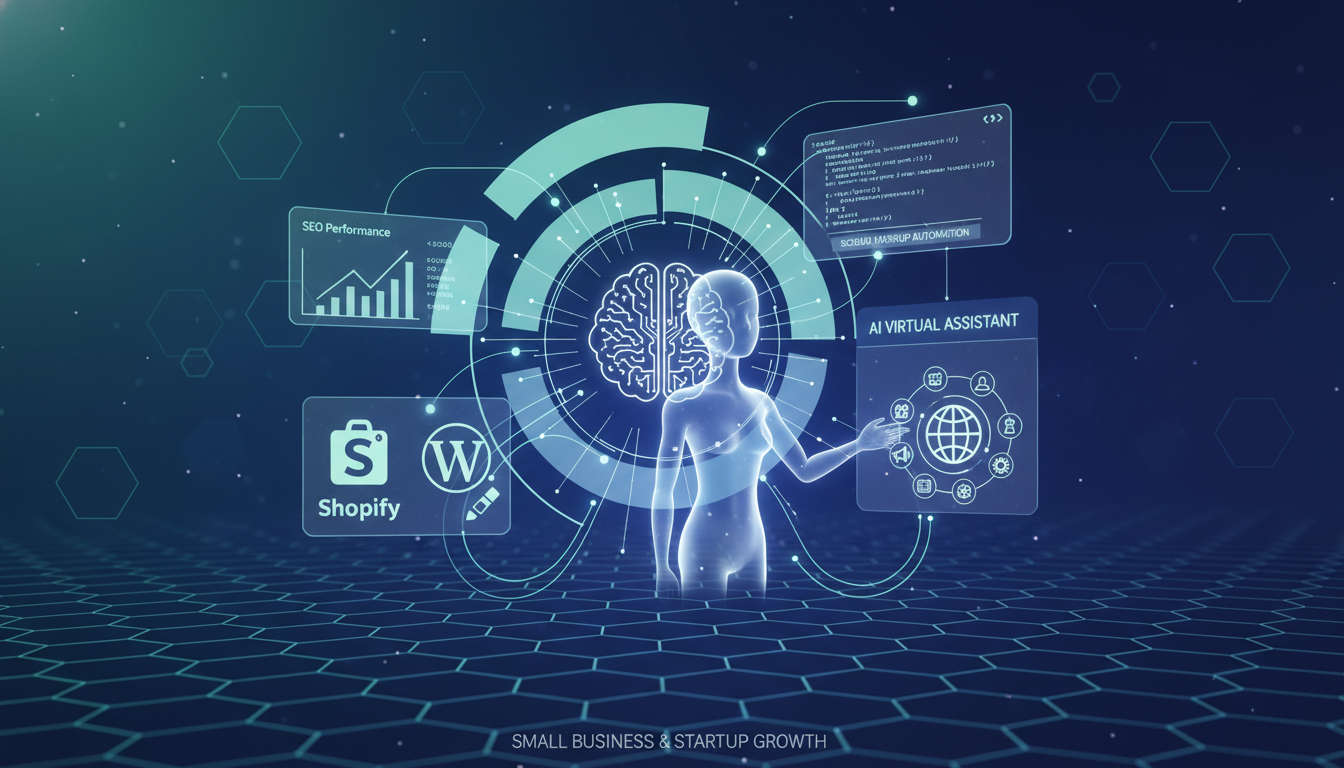
Modern digital marketing concept with AI technology and data analytics symbols representing SEO and schema markup automation for Shopify and WordPress platforms

Schema markup remains the invisible engine powering modern search visibility, yet many small businesses overlook its transformative potential. Structured data implementation has evolved from an optional enhancement into a fundamental requirement for competitive SEO performance. Furthermore, the rise of AI-driven search systems – including Google’s AI Overviews and voice search technologies – has elevated schema markup’s importance exponentially. Consequently, businesses implementing automated schema solutions are witnessing remarkable improvements in their search presence.

The current search landscape demands more than basic keyword optimisation. Search engines now interpret content meaning through structured data, enabling them to understand context, relationships, and entity connections that raw keywords cannot convey. Moreover, AI systems training on your content require schema markup to accurately comprehend your business offerings and content purpose. Additionally, schema markup proves essential for knowledge graph eligibility and credibility signals that influence AI-powered answer generation.

Why Schema Markup Matters in Today’s AI-Driven Search

Schema markup serves as the Rosetta Stone translating human-readable content into machine-readable information. This shift from traditional keyword-focused SEO to AI-powered discovery represents a fundamental change in how search engines evaluate and rank websites. Consequently, businesses that implement comprehensive schema strategies gain measurable advantages in search visibility. Furthermore, structured data enables search algorithms to extract precise information about your products, services, content, and organisation without ambiguity.

Statistics paint a compelling picture: websites implementing schema markup experience click-through rate improvements ranging from 25% to 82%, depending on schema type and implementation quality. Moreover, schema implementation directly influences eligibility for rich snippets, featured snippets, and AI Overview inclusion. Additionally, voice search – which powers over 50% of searches on mobile devices – relies almost exclusively on structured data to identify relevant answers. Therefore, omitting schema markup leaves significant organic traffic opportunity on the table.

The knowledge graph represents another critical consideration for forward-thinking businesses. Schema markup enables search engines to build comprehensive knowledge panels about your organisation, products, and expertise. Consequently, businesses with complete schema implementation gain superior positioning in knowledge panels and entity-related queries. Furthermore, AI systems utilise knowledge graph data to understand business credibility, trustworthiness, and expertise – factors increasingly important for ranking authority.

The CTR Revolution: Rich Snippets and Search Visibility

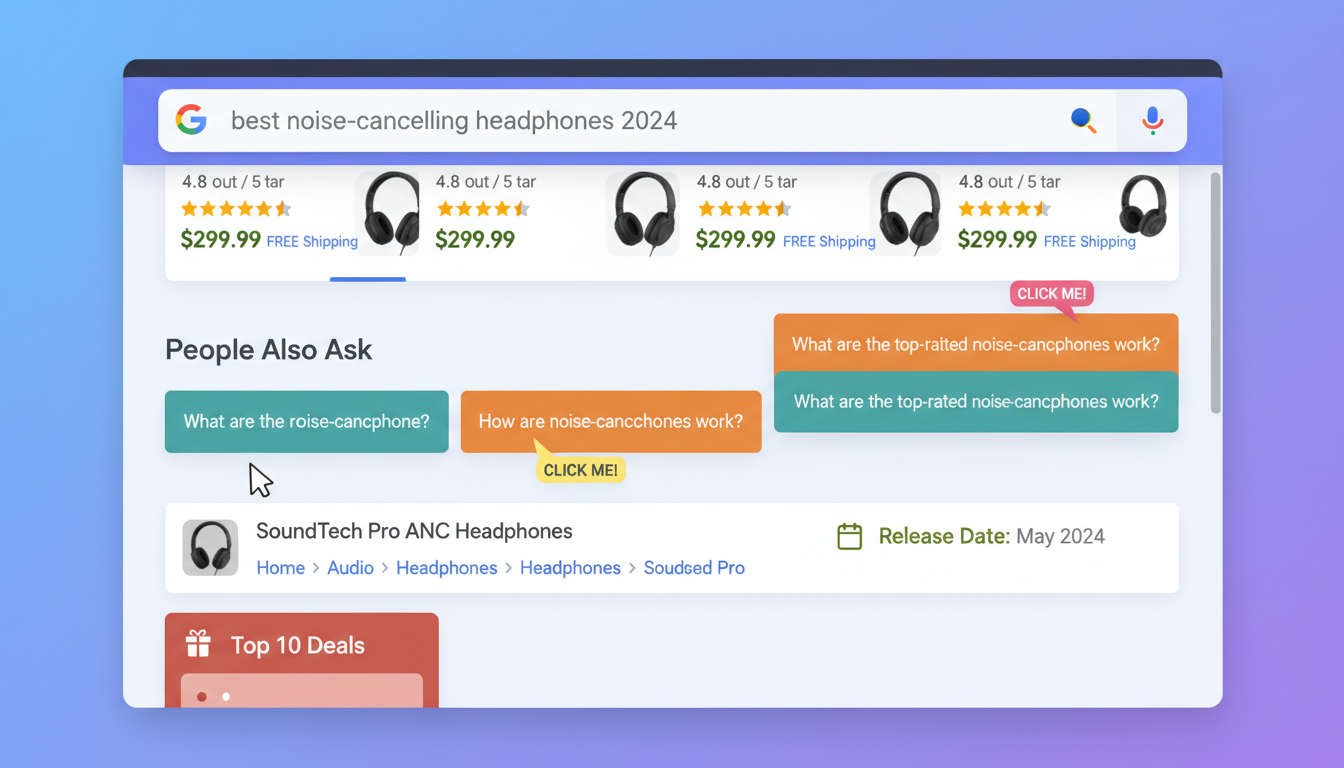
Rich snippets transform ordinary search listings into visually compelling results that capture user attention immediately. Rather than displaying simple blue hyperlinks, rich snippets incorporate visual elements including star ratings, product prices, availability status, FAQ answers, author information, and breadcrumb navigation. Consequently, these enhanced results stand out dramatically compared to standard listings, driving significantly higher click-through rates. Moreover, users perceive rich snippets as more trustworthy and relevant, boosting engagement metrics even before they reach your website.

Colourful Google search results with rich snippets including star ratings, prices, FAQs, and breadcrumbs, highlighting increased click-through rates and visibility

Different schema types deliver distinct CTR improvements. Product review schema generates 30-35% CTR increases through prominent star ratings and review counts. Furthermore, FAQ schema drives approximately 10% additional clicks by displaying answer previews directly in search results. Product details schema provides 25% CTR uplift by showing prices, availability, and product images. Additionally, overall schema implementation across multiple types produces the most impressive results: up to 82% CTR improvement when comprehensively implemented. These figures demonstrate that schema markup represents one of the highest-ROI SEO optimisations available to SMBs.

Rich snippets particularly excel within the Discover feed environment. Google’s Discover surface rewards well-structured content with enhanced visibility and impression volume. Consequently, comprehensive schema markup increases the likelihood of Discover eligibility for your content. Furthermore, structured data plays a crucial role in AI Overview inclusion – when your content appears within Google’s AI-generated answer summaries. Therefore, implementing schema markup simultaneously optimises for multiple distribution channels, not just traditional search results.

JSON-LD: The Modern Standard for Structured Data

JSON-LD (JavaScript Object Notation for Linked Data) has emerged as the dominant, Google-recommended format for schema markup implementation. Unlike earlier structured data formats such as microdata and RDFa, JSON-LD offers exceptional flexibility and ease of implementation. Moreover, JSON-LD separates markup logic from HTML structure, enabling non-intrusive code placement within the page head section. Consequently, JSON-LD implementations never interfere with page rendering, styling, or functionality – a critical advantage for automated schema deployment.

The technical elegance of JSON-LD lies in its compatibility with automation systems. Furthermore, its non-intrusive placement enables programmatic implementation without requiring theme modifications or complex HTML restructuring. Additionally, JSON-LD’s compatibility with all CMS platforms – including WordPress, Shopify, custom builds, and headless architecture – makes it the ideal foundation for universal schema automation. Consequently, platforms like Agents24x7 can deploy consistent schema strategies across diverse technical environments without friction.

JSON-LD supports sophisticated data relationships and nested objects essential for comprehensive schema implementation. For example, Product schema can nest ReviewAggregateRating objects containing comprehensive review information. Furthermore, complex pricing information including sale prices, validity dates, and currency specifications integrate seamlessly within JSON-LD structures. Additionally, schema validation against schema.org vocabulary standards ensures search engines properly interpret your markup. Therefore, JSON-LD provides the technical foundation enabling AI systems to generate intelligent, accurate schema implementations automatically.

Manual Schema Markup: The Bottleneck Problem

Traditional manual schema implementation creates cascading difficulties for small businesses and startups. Implementing schema markup across dozens, hundreds, or thousands of pages requires significant time investment from technically skilled developers. Moreover, maintaining schema accuracy becomes increasingly challenging as products, prices, reviews, and content change over time. Consequently, most SMBs never achieve comprehensive schema coverage due to resource constraints and implementation complexity.

Common mistakes plague manual schema implementation, causing errors that confuse search engines and prevent rich snippet eligibility. Incorrect property mapping, missing required fields, and validation failures often go undetected until performance problems materialise. Furthermore, QA testing each schema entry individually creates prohibitive time investments. Additionally, pricing fluctuations, inventory changes, new reviews, and content updates all require manual schema adjustments. Consequently, manual schema implementation becomes a perpetual maintenance burden rather than a one-time optimisation.

The scalability problem proves particularly acute for ecommerce businesses managing extensive product catalogues. Implementing product schema for 1,000+ products manually is essentially impossible without significant development resources. Moreover, keeping schema current as inventory changes demands continuous attention. Furthermore, most SMBs lack in-house developers or budgets for expensive contractors. Therefore, automation represents the only practical solution enabling consistent, scalable, and maintainable schema implementation for resource-constrained businesses.

AI-Powered Schema Automation: How It Works

AI-driven schema automation eliminates manual complexity through intelligent, autonomous implementation systems. The process begins with comprehensive content analysis, where AI examines your website’s pages, product data, blog posts, and metadata. Consequently, the system identifies relevant entities – products, organisations, people, locations, articles – and extracts structured information from existing content. Furthermore, natural language processing enables the AI to understand context and meaning, determining appropriate schema types for each piece of content.

A business owner working on a laptop with Shopify and WordPress logos, representing AI-driven schema markup automation in a modern workspace

After content analysis, the AI automatically generates JSON-LD schema code according to schema.org standards and Google guidelines. Moreover, the system validates all generated markup ensuring compliance with structured data requirements. Additionally, machine learning algorithms continuously improve accuracy as the system processes more content. Consequently, AI-powered automation produces consistent, error-free schema implementations without human intervention. Furthermore, bulk processing capabilities enable rapid schema deployment across entire site inventories within hours rather than weeks.

Real-time automation ensures schema remains current automatically. When product information changes, prices adjust, new reviews arrive, or inventory status shifts, the AI regenerates corresponding schema markup instantly. Moreover, the system learns your business context over time, applying increasingly intelligent schema decisions. Additionally, conditional schema generation applies different markup based on content type, category, product attributes, or other variables. Therefore, AI automation transforms schema maintenance from an ongoing burden into a fully autonomous, continuously optimised process requiring zero manual intervention.

Setting Up Schema Automation on Shopify Stores

Shopify store owners can activate AI-driven schema automation through the Agents24x7 Shopify app, available directly from the Shopify App Store. Installation requires just seconds – select the app, grant necessary permissions, and the system begins analysing your store immediately. Consequently, setup complexity is minimal, requiring no technical knowledge or coding ability.

During the initial setup process, the AI examines your existing product data, customer reviews, collections, and blog content. Furthermore, the system identifies which schema types apply to your specific business model and content structure. Additionally, configuration options enable you to select specific schema types – Product, Review, AggregateRating, FAQ, BreadcrumbList – to deploy. Consequently, customisation aligns automated schema implementation with your precise business requirements.

The system automatically generates JSON-LD schema for products, collections, blog posts, and homepage content. Moreover, you can review generated schema through a user-friendly dashboard before activation. Furthermore, Google’s Rich Results Test integration validates schema accuracy directly within the platform. Additionally, once activated, the system continuously updates schema whenever product information, prices, or reviews change. Consequently, your Shopify store maintains fresh, accurate structured data automatically without requiring manual updates.

Activating Schema Markup on WordPress Sites

WordPress site owners implement AI schema automation through the Agents24x7 WordPress plugin, available from WordPress.org. Installation follows standard WordPress plugin procedures: upload the plugin, activate it, and complete the setup wizard. Consequently, WordPress-specific implementation integrates seamlessly with your existing site architecture.

The setup wizard guides you through selecting relevant schema types for your content: Article, BlogPosting, LocalBusiness, Product (WooCommerce), FAQ, HowTo, Event, and others. Furthermore, the AI scans your existing posts, pages, products, and custom content types to understand your site structure. Additionally, configuration options address WordPress-specific considerations including taxonomy handling, featured image usage, author information, and publication metadata. Consequently, customisation ensures schema implementation aligns perfectly with your WordPress site’s unique characteristics.

The plugin requires no theme modifications, maintaining compatibility with any WordPress theme and avoiding conflicts with popular SEO plugins like Yoast. Moreover, automatic implementation activates upon plugin installation, immediately generating schema for existing content libraries. Furthermore, bulk retroactive application applies schema across thousands of historical posts simultaneously. Additionally, forward-looking automation generates schema automatically whenever you publish or edit content. Consequently, WordPress schema implementation becomes entirely hands-free after initial setup.

Beyond Basic Implementation: Schema Types for Maximum Impact

Advanced schema implementation explores specialised schema types delivering maximum CTR improvements for specific industries and content types. Product schema with pricing, availability, reviews, and offer information proves essential for ecommerce businesses. Moreover, AggregateRating schema displays prominent star ratings in search results. Furthermore, FAQ schema appears in featured snippets, capturing high-value search real estate. Consequently, targeting relevant schema types based on your content focus maximises search visibility improvements.

Article and BlogPosting schema benefit content marketing sites and blogs. LocalBusiness schema enhances visibility for service-based businesses and local operations. Event schema suits time-sensitive content promotions. HowTo schema captures how-to searches with rich results. BreadcrumbList schema improves navigation clarity and search visibility. Additionally, Organisation schema establishes brand authority and knowledge panel eligibility. Consequently, selecting appropriate schema types for your specific business model maximises SEO impact.

Nested objects create synergistic benefits when combined intelligently. For example, Product schema nested with Review and AggregateRating objects provides comprehensive product information. Moreover, different schema types work cooperatively to establish entity relationships and contextual meaning. Furthermore, industry-specific combinations often outperform individual schema types. Therefore, strategically selecting complementary schema types amplifies overall search visibility improvements beyond what individual schema types could achieve independently.

Measuring Results: Tracking Schema Impact on Performance

Measuring schema implementation’s real-world impact requires establishing clear KPIs and monitoring systems. Click-through rate improvements represent the most direct metric – compare CTR for rich snippet-eligible queries before and after schema implementation. Moreover, organic traffic increases indicate overall SEO performance improvements. Additionally, rich snippet eligibility within Google Search Console provides quantitative measures of schema effectiveness. Consequently, Google Search Console becomes essential infrastructure for schema performance monitoring.

Set up baseline measurements before activating schema automation, enabling precise before-after comparisons. Furthermore, identify which specific schema types drive the greatest CTR improvements within your business context. Additionally, monitor for schema errors using Google’s Rich Results Test and Search Console warnings. Consequently, proactive error monitoring ensures schema quality remains high throughout implementation. Moreover, track AI Overview visibility within your organic traffic, monitoring when content appears within AI-generated answer summaries.

Attribution tracking enables conversion measurement for ecommerce businesses. Furthermore, calculate ROI by comparing traffic gains against implementation time invested. Additionally, monitor ranking improvements correlated with schema deployment. Consequently, comprehensive measurement enables data-driven optimisation of your schema strategy over time.

No-Code Customisation: Tailoring Schema Without Technical Skills

Agents24x7’s platform empowers non-technical users through intuitive interfaces requiring zero coding knowledge. Business owners select which schema types apply to specific content without touching a single line of code. Moreover, conditional customisation enables rules determining when schema applies based on content characteristics. Furthermore, priority settings manage scenarios where multiple data sources provide information for the same field. Consequently, comprehensive customisation remains fully accessible to users without technical expertise.

The dashboard enables real-time schema preview before deployment, ensuring generated markup matches your expectations. Moreover, validation feedback highlights potential issues immediately. Additionally, bulk customisations apply simultaneously across thousands of content pieces. Consequently, changes execute efficiently without manual repetition across individual pages. Furthermore, multi-language schema customisation serves global businesses operating in multiple markets. Therefore, the no-code approach democratises schema implementation, enabling SMBs to execute sophisticated SEO strategies independently.

Agents24x7: The Complete Schema Automation Solution

Agents24x7 positions itself as the comprehensive AI-driven SEO solution for SMBs and startups seeking competitive advantages without excessive technical complexity or cost. The platform functions as an AI virtual employee handling 100+ SEO tasks daily, including complete schema automation alongside content research, keyword targeting, competitive analysis, and blog post generation. Moreover, the WordPress and Shopify plugins integrate seamlessly into your existing tech stack. Furthermore, at just £20/month, Agents24x7 costs significantly less than hiring developers or subscribing to expensive enterprise tools. Consequently, sophisticated AI-powered SEO becomes accessible to businesses of all sizes.

The platform’s AI learns each business’s specific context, industry characteristics, competitive environment, and audience preferences. Furthermore, this contextual understanding enables increasingly intelligent automation decisions over time. Additionally, scalability accommodates everything from small blogs to large ecommerce catalogues. Consequently, one solution serves diverse business models and growth stages. For deeper insights into related strategies, consider exploring AI on-page SEO: automate meta and schema markup, which covers complementary optimisation techniques.

Consistency represents a major competitive advantage. Rather than sporadic manual updates, Agents24x7 optimises your site continuously 24/7, ensuring schema remains current automatically. Moreover, integration with broader SEO functions creates synergistic improvements exceeding individual optimisations. Additionally, the platform’s focus on delivering measurable results aligns perfectly with SMB priorities. Therefore, automation frees business owners to focus on core business activities while AI handles technical SEO maintenance.

Real Results From SMBs Using AI Schema Automation

Small businesses across diverse industries report compelling improvements after implementing AI-driven schema automation. Ecommerce stores consistently report 25-40% CTR increases within the first 30 days, with larger cumulative gains materialising over subsequent months. Moreover, larger improvements often accumulate as schema implementation extends across product catalogues. Additionally, local service businesses report improved local search visibility through LocalBusiness and Service schema implementation. Consequently, results span across business models and industries.

Content publishers frequently achieve featured snippet eligibility through Article and FAQ schema implementation. Furthermore, cumulative schema across many pages drives compounding traffic benefits – instead of a single traffic spike, improvements grow progressively as more content benefits from rich snippet visibility. Additionally, seasonal patterns show schema impact increasing during peak search periods when rich snippet visibility matters most. Therefore, schema implementation provides lasting competitive advantages, not temporary gains. You can also review automate FAQ generation and schema for Shopify to understand FAQ schema benefits specifically.

Remarkably, these results were achieved by business owners without technical expertise – implementation and management required no coding skills whatsoever. Moreover, implementation typically completed within hours rather than weeks. Additionally, ROI became apparent within days as CTR improvements began manifesting in Search Console data. Consequently, AI-powered schema automation delivers business results efficiently and accessibly for SMBs.

The Path Forward: Schema Automation as Competitive Advantage

Schema automation transforms SEO from a technical burden into a sustainable competitive advantage for small businesses. Agents24x7’s AI-driven solution generates and maintains structured data across WordPress and Shopify sites automatically, delivering documented CTR improvements up to 82% whilst costing just £20/month. Moreover, zero technical knowledge is required – installation takes minutes, setup completes through intuitive wizards, and customisation happens entirely through no-code interfaces. Furthermore, continuous AI-powered automation ensures schema remains current as your content evolves. Therefore, comprehensive schema implementation becomes practical, affordable, and maintainable for businesses of all sizes.

The competitive landscape increasingly favours businesses embracing AI-driven optimisation. Consequently, implementing schema automation positions your business ahead of competitors still managing SEO manually. Moreover, search engines continue evolving toward greater reliance on structured data. Additionally, AI Overviews and voice search prominence elevate schema markup’s importance continuously. Therefore, today represents the ideal moment to automate schema implementation through platforms designed specifically for SMB needs. Start your AI schema automation journey today – your future search rankings will reflect this decision.

Posted on Leave a comment

Calculate AI Agent ROI & Cost Savings for SMBs

A modern small business office with a diverse team working on laptops surrounded by AI and data visualisation graphics, symbolising AI automation and productivity improvement for SMBs

Why ROI Calculation Matters for Your AI Investment

Small business owners constantly weigh automation investments against tight budgets. However, 91% of SMBs report revenue growth using AI agents, yet most still view AI as a cost rather than an investment opportunity. Furthermore, calculating ROI transforms this perception by quantifying savings and demonstrating concrete returns. Consequently, measuring your AI agent ROI creates confidence in automation decisions and justifies moving from manual processes to autonomous virtual employees.

Most SMBs lack data on labour costs and productivity metrics, making AI agent ROI calculations initially unclear. Moreover, understanding the true cost-benefit analysis reveals why a £20/month investment in autonomous AI can deliver returns within weeks. Additionally, this clarity helps justify automation decisions to stakeholders and management teams who may question automation spending.

The Hidden Cost of Manual Processes

The true cost of manual labour extends far beyond base salary. When you calculate fully loaded employee costs using the 1.25 to 1.4 factor, you’re including salary, benefits, taxes, and overhead. For example, a £30,000 annual content writer actually costs £39,000 when fully loaded. Furthermore, manual content production typically requires 5-10 business days per article, leading to inconsistent publishing schedules and missed growth opportunities.

Time waste in data entry, manual optimisation, and repetitive administrative tasks compounds monthly costs significantly. Additionally, SMBs spend 10-15 hours weekly on manual content and SEO tasks, with a typical employee costing £37.50 per hour (fully loaded). Consequently, this translates to £2,000-£3,000 per employee monthly when accounting for lost productivity and errors.

Small business owner using an AI virtual employee platform on a laptop, symbolising time and cost savings, automation, and productivity for SMBs

Building Your AI Agent ROI Calculation Framework

The core ROI formula is straightforward: ROI (%) = [(Total Benefits – Total Costs) / Total Costs] × 100. Furthermore, you must break down two critical components: Total Costs (annual AI tool cost, implementation time, training) and Total Benefits (time savings, labour cost reduction, error prevention, increased output).

To calculate hourly cost per employee, use 2,080 working hours annually as your baseline. For example, a £30,000 salary equals £14.42 per hour, or £18.03 fully loaded. Moreover, AI agents can produce 100+ tasks daily compared to realistic human output of 5-8 tasks per day. The Payback Period formula is equally important: Total Costs / Annual Net Benefits, demonstrating how a £20/month investment (£240/year) typically pays back within 2-4 months for a content-focused SMB.

Additionally, you should measure benefits conservatively at first, underestimating improvements initially, then adding benefits progressively as operations stabilise. Consequently, this approach ensures your ROI calculations are credible and defensible to management teams.

Real-World ROI Examples for Content and SEO Automation

Consider a practical example: a six-product Shopify store where the owner manually writes 2 blog posts monthly at £300 per post for freelance work. Switching to Agents24x7 at £20/month saves £7,200 annually in outsourcing costs. Furthermore, calculating monthly ROI shows £240 annual cost versus £600-£1,000 monthly savings – a 250-400% return.

Another scenario involves a WordPress service business where a team member spends 25 hours weekly on content drafting and SEO optimisation, costing £2,300 monthly. AI agent time savings of 15-18 hours weekly results in £1,725-£2,070 monthly reclaimed cost. Moreover, proven statistics show 67% of businesses using AI for content report up to 70% higher ROI, with AI content automation delivering 333% ROI in documented cases.

Additionally, a five-person SMB admin team spending 80 hours weekly on repetitive tasks can reduce this to 30 hours weekly through autonomous AI agents handling keyword research, competitor analysis, and content publishing. Consequently, freeing 250 hours monthly equals £9,375 annual value at £37.50/hour. The consistency benefit is equally important: Agents24x7 agents publish autonomously 24/7, generating 100+ tasks daily without burnout, whereas human teams miss deadlines or produce inconsistent quality due to fatigue.

Measuring Time Savings and Productivity Gains

AI agents save 40-60 minutes per blog article through drafting, keyword research, and optimisation automation. Furthermore, this multiplies to 10-15 hours weekly for typical content teams. Specific time-saving breakdowns include: keyword research automation saves 30-45 minutes per article; SEO optimisation saves 20-30 minutes; content drafting acceleration saves 15-20 minutes; publishing workflow automation saves 10-15 minutes.

Productivity metrics extend beyond time savings alone. Moreover, error reduction is significant – AI agents make fewer formatting and keyword placement errors, reducing revision time by 20-30%. Additionally, consistency improvement ensures brand voice compliance, eliminating rework and strengthening ROI calculations. Marketing teams save 240+ hours annually per professional by automating routine tasks, according to industry research.

To measure these gains effectively, track pre- and post-implementation metrics: time-to-publish, revision cycles, content output volume, and team focus time on strategic work. Consequently, time savings are easily defensible in ROI calculations because they’re directly measurable through project timelines and tool logs.

Cost Savings Beyond Labour Reduction

Manual content creation includes inconsistent keyword density, poor SEO structure, formatting errors, and missed optimisation opportunities – each requiring rework. Furthermore, AI agents reduce errors by 20-30%, directly saving revision time and improving first-publish quality. Additionally, avoiding hiring costs represents substantial savings: SMBs typically pay £2,000-£5,000 to hire and train a content or SEO specialist, plus £30,000-£50,000 annual salary. By using a £20/month AI agent instead, businesses avoid this hiring cost entirely whilst scaling output.

Opportunity cost is often overlooked but critical: manual processes delay content publication by 5-10 days, meaning SMBs miss time-sensitive trends and SEO windows. Consequently, AI agents publishing within minutes capture real-time opportunities, driving incremental traffic and revenue not captured in traditional labour cost calculations.

Tool consolidation savings deserve attention as well. Many SMBs purchase separate tools for keyword research (£50-£100/month), content creation assistance (£20-£100/month), and SEO optimisation (£50-£200/month). Agents24x7 consolidates these functions into one £20/month agent, creating 40-80% savings on overall marketing technology spend. Moreover, if an AI agent reduces reliance on platforms like Ahrefs or SEMrush by 30-50%, that’s £30-£200 monthly additional savings, making total cost savings often exceed 150-200% annually on your £20/month investment.

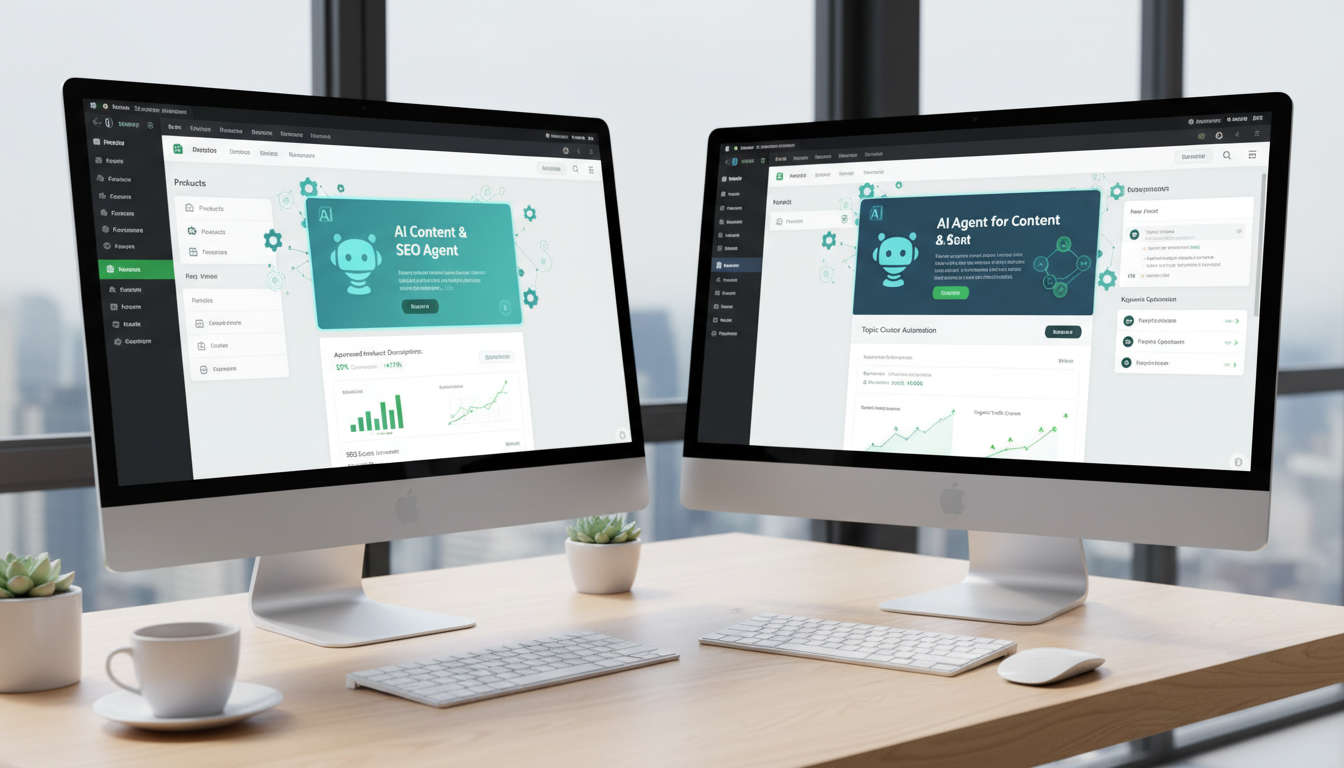
Shopify and WordPress dashboards displaying AI agent integration automating content creation and SEO optimisation, with charts and automation icons in a modern workspace

Implementing AI Agents on Shopify and WordPress

Direct integration with your platform maximises ROI realisation significantly. For Shopify stores, AI agents autonomously write product descriptions, publish blog posts optimised for store-specific keywords, manage category content, and schedule posts based on inventory and campaign calendars. Furthermore, direct Shopify integration eliminates manual data export/import, reducing publishing time by 50-70% and cutting error rates from manual platform switching.

For WordPress sites, AI agents research keywords aligned with blog strategy, write SEO-optimised posts with proper heading hierarchy and internal linking suggestions, optimise meta titles and descriptions, and schedule consistent publishing. Moreover, WordPress plugin integration allows agents to learn site history, competitor strategies, and audience preferences, improving content relevance and search rankings significantly.

Product description automation provides a compelling ROI case: automating descriptions for a 100-product store (typically £800-£2,000 outsourced or 80-120 hours in-house) costs £20/month, yielding 95%+ cost savings. Additionally, small agencies typically charge £500-£1,500 monthly for content and SEO management; in-house teams cost £40,000-£60,000 annually. Agents24x7 plugin produces equivalent output at £20/month, creating 96-98% cost reduction.

Get started with the Agents24x7 Shopify app or Agents24x7 WordPress plugin today. Furthermore, direct platform integration is essential for ROI realisation because it removes friction and ensures consistent, reliable automation without manual intervention or tool switching costs.

For detailed setup guidance, explore our AI Agent Setup: Shopify & WordPress Quick Start guide, which walks through implementation in five minutes without coding required.

Tracking, Monitoring, and Optimising Your AI Agent ROI

One-time ROI calculation is insufficient; SMBs must track metrics monthly to ensure promised benefits materialise. Furthermore, key metrics to monitor include: time tracking (hours reclaimed monthly), cost tracking (labour cost reduction), output metrics (articles published, tasks completed), quality metrics (bounce rate, engagement, conversion, keyword ranking improvements), and error rates.

Create an ROI dashboard tracking cumulative cost savings versus investment, showing payback and ongoing profit. Moreover, monthly time saved demonstrates trends, whilst content output volume and organic traffic impact reveal performance. Additionally, use UTM parameters and analytics to track traffic and conversions from AI-generated content, comparing performance against pre-automation content to quantify revenue impact.

SMBs should expect 1-3 months of setup and learning before full ROI realisation; during this period, track effort invested in training as a one-time cost amortised across years of returns. Consequently, monthly review of underperforming content themes or keywords allows strategy adjustment to focus on higher-ROI topics. For additional insights on measurement, review our Automate SEO Reporting: Performance Dashboards guide, which details AI-powered dashboards tracking real-time metrics.

True long-term ROI often exceeds early projections by 30-50% when comparing Year 1 (60-80% expected benefit realisation) against Year 2-3 (95-100% benefit realisation plus compounding gains from consistent publishing). Furthermore, quarterly business review using KPIs like cost per article, organic traffic per article, conversion rate by content piece, and payback period status ensures sustained returns. Transparency and data-driven monitoring build internal support for AI automation and justify continued investment expansion to additional tasks.

Conclusion: Your Path to Measurable AI Agent ROI

Calculating AI agent ROI is straightforward once you quantify labour costs, time savings, and operational efficiency gains. With a £20/month investment in Agents24x7, SMBs typically recover costs within 2-4 months and achieve 300-500% annual ROI through time reclamation, error reduction, and consistent 24/7 output. Furthermore, direct Shopify and WordPress integration maximises realisation, whilst tracking metrics ensures sustained returns and justifies scaling automation across your entire business operations.

Posted on Leave a comment

AI-Powered Product Description Optimisation

Futuristic robot hand interacting with digital product descriptions on transparent screens in an online marketplace, symbolising AI-powered e-commerce optimisation and automation

Why Product Descriptions Matter for E-commerce SEO

Product descriptions determine both search rankings and customer purchasing decisions. Furthermore, search engines rely on Natural Language Processing to understand product relevance through description content. Consequently, well-optimised descriptions signal product value to search algorithms and human visitors alike. According to recent data, 82% of shoppers consider product descriptions highly influential in purchasing decisions, directly impacting conversion rates and customer satisfaction.

The relationship between descriptions and search rankings proves undeniable. Moreover, top-ranking positions achieve approximately 45% click-through rates compared to rank 2 at just 17%, demonstrating how crucial optimisation truly is. Additionally, 87% of customers confirm that product content is critical for purchase decisions. This dual impact on both SEO visibility and conversions makes AI product description optimisation essential for competitive advantage. Generic or thin descriptions harm both search visibility and customer trust, inevitably leading to abandoned carts and lower conversion rates.

The Automation Challenge Every E-commerce Business Faces

Managing product descriptions at scale presents a labour-intensive challenge for SMBs and startups. Furthermore, creating unique, keyword-optimised descriptions for hundreds or thousands of products creates significant bottlenecks. Consequently, most teams resort to copying manufacturer descriptions or reusing thin content, which directly damages SEO rankings and conversion potential.

The resource drain proves substantial and often prohibitively expensive. Moreover, hiring content teams or freelancers stretches budgets whilst manual keyword research, competitor analysis, and content writing consume countless hours. Additionally, maintaining brand consistency across all product pages becomes increasingly difficult as inventory grows. This missed revenue opportunity represents thousands of pounds in lost potential when product pages fail to rank and visitors encounter uninspiring content. The financial burden of scaling content creation manually prevents growth-focused businesses from competing effectively online.

How AI Agents Transform Product Description Creation

Autonomous AI agents function as virtual employees working 24/7 without fatigue or errors. Furthermore, these intelligent systems possess core capabilities including autonomous task execution, keyword research, competitor analysis, and SEO-optimised content generation. Consequently, AI product descriptions can be created at scale whilst maintaining quality standards that manual approaches struggle to achieve.

An e-commerce business owner using AI technology on a laptop to generate multiple product descriptions automatically, with a backdrop of online store visuals and SEO graphs

AI agents learn your business model, product categories, and brand voice to maintain consistency across all descriptions. Moreover, agents can process large product inventories and generate 100+ descriptions daily whilst maintaining rigorous quality standards. Additionally, the no-code setup process ensures SMBs don’t require technical expertise to deploy these systems. The cost efficiency compared to hiring content teams positions automate product descriptions AI as a scalable investment that grows without proportional cost increases. For businesses exploring options, the Shopify app and WordPress plugin provide immediate access to autonomous content generation capabilities.

Keyword Research and Competitor Analysis Automation

AI agents automate the keyword research phase that traditionally requires hours of manual investigation. Furthermore, these systems analyse search volume, keyword difficulty, and user intent to identify high-opportunity keywords specific to each product category. Consequently, discovering hidden high-volume, low-competition keywords becomes systematic rather than hit-or-miss.

Competitor analysis follows similar automation principles. Moreover, AI agents research competitor product pages and descriptions to identify gaps and optimisation opportunities. Additionally, semantic keyword variation extends beyond exact keyword matching to understand related terms, synonyms, and long-tail variations that capture search intent. This intelligent approach to SEO product description generator technology ensures content remains competitive and continuously monitors trending keywords. The result delivers improved search visibility through keyword-targeted content that naturally incorporates high-opportunity search terms without sacrificing readability or conversion potential.

Setting Up AI-Powered Description Generation for Shopify and WordPress

Implementing Shopify AI product descriptions or WordPress solutions requires straightforward no-code setup. Furthermore, account creation and platform configuration demand no programming knowledge, making deployment accessible to all business sizes. Consequently, connecting your product database to the AI agent system happens within minutes through intuitive interfaces.

Customisation parameters allow you to define brand voice, target audience, key selling points, and SEO priorities. Moreover, you’ll establish keyword strategies that agents target in generated descriptions. Additionally, scheduling capabilities enable agents to generate descriptions on regular cadences or trigger generation automatically for new product uploads. The integration workflow includes testing phases and approval processes before descriptions go live. Both the Shopify app and WordPress plugin provide instant visibility into generated content, enabling quick reviews and adjustments before publishing. This transparent approach to WordPress AI product descriptions maintains quality control whilst accelerating content production dramatically.

Structuring Descriptions for Conversion and SEO Alignment

Optimal product descriptions balance SEO requirements with conversion goals through strategic information hierarchy. Furthermore, compelling headlines incorporate primary keywords whilst benefit-driven opening sentences capture reader attention immediately. Consequently, descriptions transition smoothly from emotional appeals and value propositions to specific product features and specifications.

A visually appealing product page layout on Shopify or WordPress showing optimised product descriptions, bullet points, high-quality images, and conversion boost indicators

Scannable formats including bullet points for key features, measurements, materials, and usage scenarios reduce buyer frustration. Moreover, quality product imagery integration increases conversions by up to 40%, whilst video content boosts conversions by up to 80% compared to static images. Additionally, trust signals within descriptions – including certifications, warranty information, and return policies – build buyer confidence. AI agents generate descriptions with semantic keyword distribution that feels natural whilst satisfying search engine requirements. Storytelling within product descriptions increases perceived value and potentially doubles conversion rates, whilst structured layouts enable returning visitor patterns and reduced abandonment rates.

Real-World Results E-commerce Businesses Achieve

Concrete examples demonstrate the transformative impact of e-commerce SEO descriptions powered by autonomous systems. Furthermore, SMB clothing retailers with 500+ products previously relying on manufacturer descriptions now deploy AI-generated unique, keyword-optimised descriptions for entire catalogues within days. Consequently, measurable outcomes include organic traffic increases, improved search rankings for product categories, and conversion rate improvements. For detailed case studies, explore our related article on Shopify SEO case studies showing 50% traffic growth in 30 days.

WordPress-based electronics stores integrating AI description generation report SEO visibility improvements and reduced reliance on paid advertising. Moreover, specific metrics show improved click-through rates from search results and increased average order value. Additionally, AI-driven optimisations have boosted conversion rates from 26% to 46% in some cases within eight weeks. Businesses maintaining 50+ customer reviews see conversion rate increases of up to 4.6%, with detailed product descriptions supporting review generation and social proof accumulation. Daily, autonomous content updates create compounding SEO advantages over competitors using static descriptions, whilst teams redirect focus from content creation to strategy and growth initiatives.

Maintaining Quality and Brand Voice at Scale

Automation concerns about quality compromise prove unfounded with proper AI implementation. Furthermore, AI agents learn and replicate your brand voice by analysing existing product content, marketing materials, and company messaging. Consequently, customisation parameters including tone preferences – professional, conversational, playful, or urgent – ensure consistency across all output.

Review and approval workflows enable team members to verify generated descriptions before publication, maintaining quality gates. Moreover, AI agents maintain consistency across all product pages, product categories, and seasonal content automatically. Additionally, iterative learning processes improve output quality as agents generate more descriptions, adapting to feedback and performance data. For comprehensive implementation guidance, our guide on AI Agent Setup for Shopify & WordPress details approval hierarchies tailored to team size and capacity. Combining AI generation with human oversight creates optimal results, balancing efficiency with quality control.

Maximising ROI with Autonomous 24/7 Content Production

The financial value proposition of continuous, autonomous product description generation proves compelling. Furthermore, AI agents operating 24/7 continuously optimise and refresh descriptions, creating compounding SEO advantages. Consequently, AI-powered e-commerce scaling becomes achievable at £20 per month – significantly lower than traditional content team expenses including salaries, benefits, tools, and training.

Return on investment flows through three primary channels: increased organic traffic reducing expensive paid advertising reliance, improved conversion rates directly increasing revenue per visitor, and reduced operational overhead eliminating manual content creation. Moreover, producing 100+ tasks daily enables rapid product catalogue expansion without proportional cost increases. Additionally, SMBs using low-cost product description tool solutions report significant improvements in search visibility and traffic. Reinvested savings from reduced advertising spend and content team expenses fund other growth initiatives, creating virtuous expansion cycles. The compounding effect of consistent daily optimisation creates widening competitive advantages, particularly when competitors rely on static, manually-created content.

Getting Started Today with Your First AI-Generated Descriptions

Actionable next steps enable immediate implementation of bulk product description generation systems. Furthermore, audit current product descriptions to identify which categories need the most improvement and which keywords underperform. Consequently, starting with pilot product groups enables testing, quality validation, and approval workflow establishment before full-catalogue scaling.

Access the Agents24x7 platform through the Shopify app or WordPress plugin depending on your platform choice. Moreover, set initial parameters including brand voice preferences, keyword targets, and content quality standards. Additionally, establish approval procedures with your team and track baseline metrics before implementing AI-generated descriptions. Monitor improvements in search visibility, click-through rates, and conversion performance. The iterative refinement process ensures feedback from initial results guides system configuration adjustments, whilst ongoing maintenance including periodic description refreshes and seasonal updates keeps content competitive. This systematic approach to autonomous product content generation delivers sustainable competitive advantages in crowded e-commerce markets.

Posted on Leave a comment

Automate SEO Reporting: Performance Dashboards

Modern AI-powered SEO dashboard with charts and graphs displayed on computer and mobile devices, symbolising automation and real-time analytics for small businesses and startups.

Why Manual SEO Reporting Is Costing Your Business Time and Money

Manual SEO reporting drains resources from strategic growth initiatives. Consequently, most SMBs and startups struggle with the time investment required to compile data from Google Analytics, Google Search Console, rank tracking tools, and backlink platforms weekly. Furthermore, 70% of marketers prioritise SEO yet spend 8-10 hours monthly on manual dashboards, spreadsheet updates, and PDF exports. Additionally, this fragmented approach leads to delayed insights and missed optimisation opportunities.

The opportunity cost is substantial. Time spent generating reports means less time available for content creation, strategy refinement, and actual business growth initiatives. Moreover, delayed insights prevent rapid response to ranking changes or traffic fluctuations. Consequently, stakeholders struggle to understand SEO ROI without automated reporting demonstrating value. Furthermore, this inefficiency becomes increasingly problematic as businesses scale across multiple websites or manage portfolios for clients. Therefore, automated reporting solutions become essential investments rather than nice-to-have luxuries.

Understanding AI-Powered SEO Dashboards and Real-Time Performance Tracking

AI-powered SEO dashboards fundamentally transform how organisations monitor organic performance. Unlike traditional reporting methods requiring manual data compilation, these dashboards automatically integrate data from multiple sources including Google Analytics 4, Google Search Console, rank tracking systems, and competitor monitoring tools into unified interfaces. Moreover, real-time capabilities enable instant visibility into organic traffic fluctuations, ranking changes, and emerging opportunities. Consequently, marketing teams respond faster to algorithm changes and performance shifts.

AI-powered SEO dashboard interface showing real-time performance metrics for organic traffic, keyword rankings, backlink acquisition, and conversion rates on multiple device screens including WordPress and Shopify dashboards

Machine learning algorithms identify performance patterns, predict future trends, and recommend optimisations based on historical data. Additionally, AI-driven anomaly detection alerts marketers to sudden performance shifts before they become critical issues. These dashboards provide customizable widgets, mobile-responsive layouts, and white-label capabilities particularly useful for agencies. Furthermore, they integrate natively with WordPress and Shopify ecosystems, connecting seamlessly with platform-specific SEO plugins and ecommerce metrics. Consequently, organic traffic growth trajectories, keyword ranking movements, backlink acquisition rates, and conversion contributions from organic search become instantly visible.

Key Metrics Every Dashboard Should Track for Measuring SEO Success

Automated SEO dashboards must monitor essential KPIs that demonstrate organic performance. Organic traffic volume serves as the foundation metric, with consistent month-over-month growth targets around 15% indicating successful strategies. Moreover, keyword rankings for both competitive terms and long-tail keywords require tracking, as long-tail keywords drive approximately 70% of search traffic. Additionally, click-through rates from search results matter significantly – first-position pages average 22% CTR versus 3-5% for lower positions.

Bounce rate monitoring identifies pages where visitors exit prematurely, indicating content or user experience issues requiring attention. Furthermore, conversion rate tracking connects organic visitors to actual business outcomes – essential for demonstrating SEO ROI to stakeholders. Consequently, businesses discover that small companies under £1M revenue see 2.6x ROI at 12 months, whilst the £1-10M band achieves strongest 3.3x ROI, making metric tracking business-critical. Additionally, backlink metrics including new links acquired, referring domain quality, and link velocity indicate authority growth. Core Web Vitals monitoring ensures loading speed remains under 2.5 seconds, interactivity under 200ms, and visual stability under 0.1.

How AI Agents Automate Weekly SEO Report Generation for WordPress and Shopify

AI agents work behind scenes automating SEO report generation specifically for WordPress and Shopify platforms. The workflow process involves AI agents automatically extracting data from integrated sources every 24 hours, calculating metric changes since the previous period, analysing performance against established benchmarks, and generating narrative summaries interpreting results. Moreover, these agents configure to focus on WordPress-specific metrics like blog post performance, page indexation, and internal linking structure. Additionally, Shopify-specific configuration addresses product page rankings, collection page optimisation, and ecommerce conversion attribution concerns.

Small business owner working on laptop analysing automated weekly SEO report generated by AI agents with visible charts and data on screen, modern office background

Scheduling functionality generates reports on defined cadences – weekly, bi-weekly, or monthly – automatically distributing to stakeholders via email or dashboard access. Consequently, teams receive insights without manual compilation requests. Furthermore, AI agents learn business objectives over time, adapting report focus to strategic priorities rather than creating generic reports. Additionally, platforms like Agents24x7 available on Shopify handle 100+ autonomous tasks daily, enabling real-time report generation and continuous performance monitoring. Moreover, these agents handle WordPress custom post types, Shopify variants, and dynamic pricing changes when analysing performance. Furthermore, security and data privacy remain paramount when integrating AI agents with business data sources.

Converting SEO Metrics into ROI and Revenue Attribution Models

Automated dashboards translate SEO metrics into quantifiable ROI resonating with business stakeholders. SEO delivers average 22:1 ROI ratio – £1 invested generates approximately £22 in return, yielding average 748% campaign ROI. Consequently, establishing baseline metrics before implementing SEO improvements enables tracking typical 6-12 month positive ROI timelines for SMBs. Moreover, attribution models connecting organic traffic to revenue generation consider multi-touch scenarios where organic visits contribute alongside other channels. Additionally, customer lifetime value from organic channels represents critical metrics for demonstrating long-term SEO value.

Segmentation by traffic source, product category, or service type isolates organic contribution precisely. Furthermore, incremental revenue contribution – additional revenue above baseline levels since SEO implementation – demonstrates tangible value. Industry-specific ROI benchmarks show SaaS achieving 702% ROI with 7-month breakeven, real estate reaching 1,389% ROI with 13-month breakeven, and ecommerce sites attaining 317% ROI with 16-month payback periods. Consequently, forecasting capabilities where AI predicts future revenue based on current SEO performance trajectories enable strategic planning. Additionally, presenting findings to non-technical stakeholders using clear visualisations and actionable recommendations tied directly to business growth objectives ensures organisational buy-in. If you’re measuring ROI from broader automation efforts, explore our comprehensive guide to measuring ROI from AI automation for SMBs.

Setting Up Your First AI-Powered SEO Dashboard in 60 Minutes

SMBs and startups can establish their first AI-powered SEO dashboard rapidly through systematic setup. Begin with platform selection – whether choosing dedicated AI SEO platforms like Agents24x7 WordPress plugin priced at £20/month with 100+ daily tasks capability, or building custom solutions through Looker Studio, Power BI, or Tableau integrated with existing tools. Moreover, WordPress-specific setup requires plugin installation, Google Search Console connection via Rank Math or Yoast SEO integrations, and Google Analytics 4 account linking. Additionally, Shopify configuration includes app installation, Shopify admin account linking, and ecommerce-specific metric enablement.

Data source connections pull organic impressions and clicks from Google Search Console, organic traffic metrics from Google Analytics, daily or weekly ranking updates from rank tracking tools, and backlink data. Furthermore, dashboard customisation focuses on business priorities – prioritising conversion metrics for lead-generation sites versus ranking and traffic metrics for content-focused properties. Consequently, widget placement becomes critical for at-a-glance insights, historical trend analysis, and actionable alerts. Additionally, quality setup requires 30-60 minutes for standard implementations, with ongoing maintenance minimal once automated agents handle continuous data collection and analysis. User access configuration ensures team members, stakeholders, and clients view appropriate data segmented by role and responsibility.

Advanced Dashboard Features That Drive Strategic Decision Making

Sophisticated dashboard capabilities transform raw data into strategic intelligence. Predictive analytics features forecast traffic trends, ranking movements, and revenue contribution based on historical patterns and algorithm updates. Moreover, scenario modelling visualises potential outcomes – for instance, simulating expected organic growth from targeting 50 new keyword opportunities. Additionally, competitor benchmarking dashboards compare your performance against industry rivals, showing where you’re winning, losing ground, or missing opportunities. Consequently, strategic positioning becomes data-informed rather than assumption-based.

Segmentation capabilities enable drill-down analysis by traffic source, keyword category, geographic location, device type, and user demographics. Furthermore, custom alerts notify teams of opportunities like “20 keywords moved into top-10 positions this week” and threats like “organic traffic dropped 15% – investigate algorithm updates”. Additionally, multi-channel attribution shows how organic traffic contributes within broader customer journey sequences alongside email, paid, referral, and direct traffic. Moreover, API connections enable automated action triggers – automatically creating content briefs for underperforming target keywords or flagging indexation issues for developer attention. Consequently, reporting shifts from passive observation to active, insights-driven management.

Integrating SEO Reporting with Content Strategy and Campaign Management

Automated dashboards connect reporting insights directly to content creation and campaign planning workflows. Dashboard alerts identifying high-potential keyword opportunities automatically trigger content briefs feeding into editorial calendars. Moreover, underperforming content receives optimisation flagging while top-performing content informs strategy for future topic clusters and content gaps. Additionally, conversion attribution from specific content pieces guides editorial priorities – focusing resources on topics generating both traffic and revenue. Consequently, content investments become data-driven rather than speculative.

Dashboard insights influence WordPress category structure, internal linking strategies, and featured content placement. Furthermore, Shopify implementations use product page performance data for merchandising decisions, collection optimisation, and keyword-targeted category naming. Additionally, campaign-specific dashboards isolate performance for seasonal promotions and product launches, enabling comparison between periods. For more on comprehensive SEO optimisation strategies, consult our guide to SEO audit automation for Shopify and WordPress sites. Moreover, multichannel dashboards connect SEO to broader marketing campaigns – showing whether SEO supports paid advertising goals, social media campaigns, and email initiatives. Consequently, historical performance data builds organisational knowledge about what content types and optimisation strategies work best for specific audiences.

Scaling Automated Reporting Across Multiple Sites, Teams, and Clients

Agencies and multi-site operators scale automated reporting efficiently through centralised dashboard architecture. This approach aggregates performance from multiple WordPress installations, Shopify stores, or mixed platforms into unified views maintaining site-specific drilldown capability. Moreover, user role management and permission structures enable executives viewing high-level KPIs whilst content teams see content-specific metrics and technical teams access crawl data. Additionally, white-label customisation enables agencies presenting client reporting under their own branding whilst maintaining centralised data collection.

Batch reporting automation generates client-specific reports covering multiple properties with customised insights relevant to each business’s objectives. Furthermore, consistent KPI definitions across multiple sites enable meaningful comparative analysis. Consequently, data consolidation challenges – including synchronisation latency and maintaining consistency – require systematic solutions. Additionally, team collaboration workflows automatically route reporting insights to relevant stakeholders. Platforms supporting 100+ daily tasks like Agents24x7 enable scaling without proportional cost increases, making distributed reporting practical for resource-constrained teams. Moreover, archive and compliance capabilities ensure reporting data retention meets audit requirements. Consequently, competitive intelligence and operational efficiency scale with organisational growth.

Conclusion

Automated SEO reporting powered by AI transforms how SMBs and startups measure, understand, and optimise organic performance. By eliminating manual reporting drudgery, organisations gain real-time visibility into traffic, rankings, and ROI – enabling data-driven strategy and faster decision-making. AI-powered dashboards deliver the competitive intelligence and operational efficiency necessary for scaling sustainable organic growth whilst keeping costs manageable and maintaining competitive advantage.

Posted on Leave a comment

AI Internal Linking: WordPress & Shopify

Modern digital workspace with AI technology automating SEO tasks on WordPress and Shopify, symbolising internal linking and data flow for small businesses and startups

Why Internal Linking Matters More Than Ever

Internal linking stands as one of the most powerful yet underutilised SEO strategies for small businesses and startups. Furthermore, search engines depend heavily on internal links to understand your site’s architecture and content relationships. Consequently, websites with well-structured internal linking experience organic traffic increases of up to 30 percent within weeks of implementation.

Modern search engines now use internal linking to evaluate topical authority and establish your expertise in specific subject areas. Additionally, internal links distribute page authority throughout your domain, concentrating link equity strategically on your most important pages. However, most SMBs neglect internal linking due to resource constraints, creating significant competitive disadvantages against organisations that prioritise this fundamental SEO tactic.

Interconnected web pages representing internal linking and SEO strategy for WordPress and Shopify websites

Manual internal linking approaches remain time-consuming and inconsistent, requiring constant oversight and expertise. Manual strategies often fail to identify orphan pages – valuable content that lacks incoming links entirely – and miss contextual linking opportunities that AI systems naturally discover. Furthermore, semantic internal linking powered by artificial intelligence ensures links connect genuinely related pages based on content context, not just superficial keyword matching.

How AI Agents Transform Internal Linking Workflows

AI-driven internal linking automation revolutionises how SMBs approach SEO infrastructure. Intelligent agents analyse your entire website continuously, identifying topically related pages and suggesting contextually relevant linking opportunities without requiring manual intervention. Moreover, these autonomous systems work 24/7, scanning newly published content, flagging orphan pages, and proposing link placements in real time.

Agents24x7 specifically utilises autonomous agents capable of handling over 100 tasks daily, including comprehensive link analysis, opportunity identification, and performance monitoring. Traditional SEO plugins require constant manual configuration and ongoing oversight, whereas AI agents learn from your business structure and adapt linking strategies automatically as your site grows. Additionally, the no-code nature of AI-powered solutions means business owners and marketing teams can implement sophisticated internal linking without requiring developer expertise.

Small business owner using AI tools on laptop managing Shopify store and WordPress blog with SEO metrics and AI agent assistance

Setting Up AI Internal Linking on WordPress

The Agents24x7 WordPress plugin simplifies internal link optimisation for bloggers and website owners of all technical levels. Furthermore, the installation process proves straightforward through your WordPress dashboard, requiring just a few clicks to activate automated internal linking capabilities. Consequently, within minutes of setup, your AI agent begins analysing existing content and identifying linking opportunities across your entire blog.

Initial configuration involves selecting your preferred automation level, defining topical clusters and keyword hierarchies that reflect your business focus. Moreover, you can establish link rules including minimum link density thresholds, maximum links per page, and preferred anchor text patterns. Additionally, the plugin allows you to identify primary authority pages deserving increased incoming link equity and secondary pages requiring distribution of that authority.

The intuitive dashboard displays actionable suggestions, enabling you to approve automatic link placements or refine recommendations before they publish. Furthermore, email notifications alert you to new linking opportunities and performance milestones, ensuring you stay informed without constant manual checking. The plugin integrates seamlessly with existing WordPress SEO tools and content management workflows, eliminating the need for additional software or complex configurations.

For those seeking a quick-start approach to automation, the AI Agent Setup: Shopify & WordPress Quick Start guide provides step-by-step instructions for implementation within minutes. This comprehensive guide covers everything from initial setup through launching your first automated linking campaigns.

Configuring AI Internal Linking for Your Shopify Store

Shopify store owners benefit significantly from automated internal linking that connects product pages, collections, and blog content strategically. The Agents24x7 Shopify app integrates seamlessly into your store’s architecture without requiring code modifications or technical development. Therefore, eCommerce entrepreneurs can activate sophisticated internal linking without enlisting developer support.

Configuration focuses on eCommerce-specific linking structures, such as linking blog posts to relevant products, connecting related items within collection hierarchies, and establishing category-to-product patterns that guide customers naturally through your inventory. Moreover, the app balances SEO benefits with conversion optimisation, ensuring links guide customers toward purchasing decisions rather than causing distraction. Consequently, strategic linking directly contributes to improved product discovery and increased average order value.

The app automatically handles unique Shopify elements including collections, tags, and product variants, creating logical linking structures that enhance both search engine crawlability and customer navigation. Furthermore, you can prioritise high-traffic pages for distributing authority to underperforming products, strategically concentrating link equity where it drives the most value. The system’s approach to anchor text optimisation accounts for Shopify’s template constraints, ensuring natural, conversion-focused link placement that respects your store’s design.

Measuring and Optimising Internal Linking Performance

Tracking internal linking success requires monitoring key performance indicators that reveal both SEO and user engagement improvements. SMBs should observe organic traffic changes, bounce rate reductions, average session duration improvements, and pages per session metrics to gauge overall effectiveness. Additionally, integration with Google Search Console data identifies which internal links drive the most valuable traffic and which pages benefit most from increased internal link authority.

Crawl budget optimisation metrics demonstrate how improved internal linking helps search engines discover and index your content more efficiently. Furthermore, analysis of user behaviour data alongside linking metrics ensures AI-placed links align with genuine visitor interests and natural navigation patterns. Consequently, this data-driven approach continuously refines your linking strategy, ensuring ongoing improvements month after month.

The reporting dashboard visualises linking health, identifies broken links, flags orphan pages, and shows link equity flow throughout your entire site structure. Moreover, A/B testing approaches within internal linking compare different strategies to determine which patterns drive superior SEO and engagement outcomes. Additionally, establishing baseline metrics before implementation provides clear benchmarks for measuring success and adjusting tactics as needed.

Boosting SEO Rankings and Google Discover Visibility

Effective AI-driven internal linking directly improves search engine rankings and increases visibility on Google Discover. Strategic link placement concentrates page authority on key ranking targets, accumulating domain authority in ways that benefit your entire site. Furthermore, improved crawlability ensures search engines discover and index important content faster, reducing the time new pages spend in indexing pipelines.

Semantic internal linking creates topical authority signals that help Google understand your site’s subject matter expertise – increasingly crucial for EEAT (Experience, Expertise, Authoritativeness, Trustworthiness) evaluation. Google Discover specifically favours well-structured, interconnected content demonstrating authoritative coverage of topics, directly benefiting from strong internal linking architecture. Consequently, investment in internal linking yields compounding SEO benefits across multiple ranking factors and discovery channels.

For detailed insights into transforming your site’s search performance, the case study “Shopify SEO Case Study: 50% Traffic Growth in 30 Days” illustrates real-world results achieved through strategic SEO automation. This documented example demonstrates precisely how internal linking combines with other optimisation techniques to drive significant, measurable organic growth.

Reducing Bounce Rates and Enhancing User Engagement

Strategic internal linking powered by AI significantly reduces bounce rates by providing clear pathways for users to explore additional content aligned with their interests. Relevant contextual links transform single-page visits into multi-page sessions, substantially extending user engagement. Moreover, reduced bounce rates occur when visitors discover valuable related content, signalling content quality to both users and search engines.

Engagement metric improvements – including increased time on site, pages per session, and scroll depth – result naturally from compelling internal linking. Furthermore, AI ensures links appear contextually within content where users naturally encounter them, increasing click-through rates compared to generic sidebar or footer links. Consequently, contextual placement makes internal links feel relevant and helpful rather than intrusive to visitors.

The psychological principle of “confidence clicking” explains why clear, descriptive anchor text in well-placed links encourages users to explore further. Additionally, personalised link suggestions based on content topics and user behaviour patterns create seamless user experiences that reduce friction. Improved engagement signals strengthen your site’s reputation with search engines, creating a positive feedback loop where better user experience drives better rankings.

No-Code Implementation and Ongoing Support

Agents24x7’s no-code approach eliminates technical barriers preventing most SMBs from implementing sophisticated internal linking strategies. The platform requires no coding knowledge, server access, or developer involvement, enabling business owners and marketing teams to manage internal linking independently. Moreover, the user-friendly interface and dashboard provide clear prompts, tooltips, and guided workflows designed specifically for non-technical users.

AI handles all technical complexities automatically, including URL structure analysis, link architecture optimisation, and database management. Furthermore, comprehensive support and training resources – including documentation, video tutorials, and direct support channels – ensure users feel confident managing their automation. Additionally, the monthly subscription model at £20 provides access to all automation features, unlimited internal linking, continuous 24/7 monitoring, and regular feature updates without additional implementation costs.

This pricing model compares favourably to hiring SEO specialists or purchasing expensive enterprise tools requiring implementation and ongoing technical support costs. The platform scales seamlessly from small startup blogs to established multi-thousand-page eCommerce stores without additional complexity. Moreover, Agents24x7 maintains compliance with platform security standards and data protection regulations, addressing common SMB concerns about automation and data privacy.

For businesses seeking WordPress automation solutions, the Agents24x7 WordPress plugin delivers enterprise-grade capabilities at SMB-friendly pricing, enabling consistent daily content and internal link automation.

Real-World Results and Success Metrics for SMBs

SMBs using Agents24x7 consistently report measurable improvements across crucial performance metrics. WordPress bloggers increase organic traffic by 30 percent through improved crawlability, whilst Shopify store owners reduce product page bounce rates by 40 percent through strategic linking to complementary products. Furthermore, content-heavy websites eliminate orphan pages and establish topical authority, positioning themselves as industry thought leaders.

Time savings metrics demonstrate how SMBs reduce internal linking work from 5-10 hours weekly to minimal oversight, freeing resources for strategic content creation and business development. Consequently, this operational efficiency translates directly to improved business profitability. Additionally, tangible business outcomes include increased lead generation from improved blog visibility, higher eCommerce conversion rates from optimised product page accessibility, and improved ranking positions for commercial keywords.

Consistency of AI automation – operating 24/7 and continuously optimising – drives cumulative improvements that manual approaches cannot match. Ranking gains compound month after month as your site’s internal linking architecture strengthens. Pages index within days instead of weeks, internal link click-through rates increase from 2-3 percent to 12-15 percent through contextual placement, and organic session growth reaches 15-25 percent within the first quarter. Furthermore, smaller competitors using Agents24x7 have captured market share from larger competitors neglecting internal linking strategy entirely.

Transform Your SEO With AI Internal Linking Automation

AI internal linking automation removes one of SMBs’ greatest SEO obstacles, delivering consistent, intelligent link placement at enterprise scale. By implementing Agents24x7’s WordPress plugin or Shopify app for just £20 monthly, small businesses gain sophisticated SEO capabilities that reduce bounce rates, boost rankings, and drive sustainable organic growth without requiring technical expertise or ongoing manual effort. Furthermore, the 24/7 autonomous operation ensures your internal linking strategy evolves continuously as your content grows. Consequently, your competitive advantage strengthens every single day through relentless, intelligent automation that works while you focus on building your business.

Posted on Leave a comment

Shopify SEO Case Study: 50% Traffic Growth in 30 Days

Modern Shopify store workspace with laptop showing SEO analytics and AI automation elements symbolising small business growth and 24/7 virtual AI employee assistance

The Store’s Initial Challenge

A boutique Shopify e-commerce store faced a common struggle: organic traffic stalled at approximately 2,000 monthly sessions. Furthermore, their conversion rate hovered around 1.8%, generating roughly £6,000 in monthly organic revenue. However, they lacked the resources to execute consistent SEO efforts manually. Consequently, competitors dominated their target keywords whilst they remained trapped on page 2-3 of Google results.

The store owner recognised a critical gap. Additionally, they spent 10-15 hours weekly on content creation and SEO tasks without seeing meaningful improvements. Moreover, hiring a freelance content writer would cost £500-800 monthly – a significant expense for a small business. Yet they understood that consistent content publishing directly impacts search rankings. Therefore, they began exploring AI-powered alternatives that could deliver 24/7 autonomous content generation.

Discovering Agents24x7 as the Solution

After evaluating several AI content tools, the store owner discovered Agents24x7. Furthermore, the platform’s key features aligned perfectly with their needs: a £20/month subscription, autonomous operation producing 100+ tasks daily, and seamless Shopify app integration. Consequently, they understood the value proposition immediately – professional SEO automation at a fraction of traditional agency costs.

What made Agents24x7 stand out? Additionally, it functioned as a true AI agent virtual employee rather than merely a writing tool. Moreover, it combined keyword research, competitor analysis, content generation, and autonomous publishing into one cohesive platform. The store owner appreciated the WordPress plugin availability for future multi-channel expansion. Therefore, they initiated a free trial to test the platform’s capabilities.

Setting Up Through the Shopify App

The installation process proved remarkably straightforward. Furthermore, they accessed the Shopify App Store, searched for Agents24x7, and clicked Install within minutes. Consequently, the app requested standard permissions via OAuth, and within 45 minutes, complete configuration was finished.

A Shopify ecommerce store owner installing and configuring a Shopify app with SEO keywords and product categories displayed on the screen in a bright professional setting

The setup included essential steps: connecting Google Analytics for baseline data, identifying target keywords and product categories, configuring daily publishing schedules, and setting brand voice preferences. Additionally, they integrated the WordPress plugin for simultaneous blog syndication across both platforms. Moreover, they established SEO parameters including content types (blog posts, product descriptions, collection pages) and target keyword clusters. Consequently, the AI agent possessed all necessary information to begin autonomous operations.

Autonomous Operation and Content Generation

Once configured, Agents24x7 operated continuously without human intervention. Furthermore, the AI agent performed daily keyword research using Google Trends data, analysed competitor content, and identified content gaps systematically. Consequently, it generated 5-10 optimised blog posts daily whilst creating enhanced product descriptions and collection page content.

A futuristic autonomous AI agent analysing SEO keywords and generating blog posts and product descriptions with glowing digital data flow elements

The platform’s effectiveness stemmed from its intelligent strategy. Additionally, it focused on long-tail keywords targeting specific product queries rather than attempting to rank for highly competitive head terms. Moreover, it balanced content across all buyer journey stages: awareness, consideration, and decision. Consequently, the content felt natural whilst maintaining strict SEO optimisation standards. Furthermore, it automatically generated schema markup, managed canonical tags, and scheduled publications for optimal crawl timing. Therefore, every piece of content launched maximally optimised without manual intervention.

Real Performance Data Over 30 Days

Week one established the baseline: 2,000 organic monthly sessions, 45 indexed pages, and average keyword rankings at positions 18-22. Furthermore, the initial content began indexing during week two with 15 new pages added. However, traffic remained relatively flat at approximately 2,050 sessions as search engines required time to evaluate new content.

Week three brought visible acceleration. Additionally, indexed pages reached 85 total with roughly 60 keywords entering the top 50 positions. Consequently, organic traffic climbed to 2,400 monthly sessions as search engines granted the new content visibility. Furthermore, users began clicking through to product pages and blog content at significantly higher rates.

By week four, results became dramatic. Moreover, the store indexed over 130 pages with approximately 200 keywords ranking in the top 50 positions. Consequently, organic traffic reached 3,000 monthly sessions – a remarkable 50% increase from the baseline. Furthermore, 15 keywords moved from position 30+ into the top 10, whilst 45 additional keywords entered the top 20. Therefore, the conversion rate improved to 2.2% as more qualified traffic arrived through superior keyword targeting.

ROI and Financial Impact

The financial analysis proved compelling. Furthermore, total implementation costs comprised £20 for monthly subscription plus approximately £50 in setup labour (2 hours at £25/hour), equalling £70 total investment. Consequently, the store generated an additional £3,000 in monthly organic revenue – a direct result of improved search visibility.

This calculates to a 4,185% first-month ROI. Moreover, ongoing monthly ROI reaches 15,000% annually if improvements sustain as projected. Furthermore, compare this against traditional solutions: hiring freelance content writers costs £500-800 monthly for 4-8 blog posts, whilst Agents24x7 produced 150+ optimised content pieces for £20 – a 25-40x cost efficiency advantage. Additionally, the store recovered 50 hours monthly previously spent on content creation, worth approximately £1,250 in labour value. Therefore, total value creation exceeded £4,250 monthly despite the modest £20 investment.

Learn more about calculating returns in our comprehensive guide: Calculate AI Agent ROI: SMB Savings Guide. This resource reveals real-world SMB examples achieving 200-500% annual returns from identical investments.

Scaling Success Long-Term

The initial 30-day success established momentum for sustained growth. Furthermore, the 3,000 daily organic sessions created a foundation for organic backlink accumulation through content marketing initiatives. Consequently, domain authority improved as more indexed pages generated internal linking opportunities. Moreover, the network effect meant exponential keyword coverage expansion into long-tail variations.

Critical advantage: the £20/month cost remained fixed regardless of growth scale. Furthermore, a store doubling to 6,000 monthly organic sessions still invests only £20, creating margin expansion impossible with traditional agencies. Additionally, competitors publishing monthly content face ranking fluctuations; however, Agents24x7’s 24/7 operation maintains consistent search algorithm favour. Consequently, projections suggested 5,000+ organic sessions by month six and 8,000+ by month twelve – representing 300-400% year-over-year growth from a single solution.

For rapid setup guidance, explore: AI Agent Setup: Shopify & WordPress Quick Start. This resource enables setup completion within five minutes on either platform.

Key Learnings for Other SMBs

This case study reveals several critical lessons. Firstly, consistency matters more than perfection – daily imperfect content outranks occasional manually-crafted pieces. Furthermore, long-tail keywords drive immediate SMB results without established domain authority. Consequently, this store’s 200-500 word targeted articles proved more effective than competing for head terms.

Secondly, technical SEO automation eliminates time-consuming manual tasks. Moreover, schema markup generation, canonical tag management, and metadata optimisation now occur autonomously. Therefore, human resources focus on higher-value strategic activities. Additionally, content distribution across multiple platforms exponentially increases visibility. Furthermore, simultaneous Shopify and WordPress publishing multiplied backlink opportunities compared to single-channel approaches.

For comprehensive SEO auditing, consider: SEO Audit Automation for Shopify & WordPress. This solution detects issues continuously, ensuring optimal performance.

Thirdly, real-time data integration enables responsive marketing. Furthermore, the AI agent responds to trending searches and seasonal opportunities competitors miss through quarterly planning. Moreover, autonomous 24/7 operation creates compounding advantages search algorithms reward through freshness signals. Consequently, small businesses achieve competitive parity with larger retailers through superior automation.

Practical Implementation Recommendations

For businesses considering AI-powered SEO automation, establish baseline metrics before implementation to quantify improvements definitively. Furthermore, set realistic expectations understanding that 30 days represents the minimum timeline for significant results – though improvements typically appear in weeks 2-3. Moreover, focus on organic revenue and qualified traffic rather than vanity metrics like total session count.

Additionally, integrate AI tools with existing ecosystems rather than treating them as isolated solutions. The Agents24x7 Shopify app and WordPress plugin work synergistically to amplify results. Furthermore, adequate setup time ensuring proper keyword targeting directly impacts performance. Monitor results weekly, making strategic adjustments to improve outcomes continually. Consequently, long-term sustainability requires understanding that exceptional results extend beyond initial months as content libraries and domain authority accumulate exponentially.

Conclusion

This Shopify store’s 50% organic traffic growth within 30 days demonstrates that small businesses can achieve substantial search results through autonomous AI agents. Furthermore, the £20/month investment generated 4,185% first-month ROI through consistent daily content production and intelligent keyword targeting. Consequently, SMBs no longer accept competitive disadvantage due to limited marketing budgets – autonomous AI platforms level the playing field. Moreover, the combination of technical SEO automation, consistent publishing, and data-driven decision-making creates advantages traditional manual approaches cannot match. Therefore, Agents24x7 represents essential infrastructure for cost-conscious businesses seeking competitive search visibility and sustainable organic growth.

Posted on Leave a comment

AI Email Marketing Automation for SMBs

Modern small business office with digital marketing icons and AI elements illustrating email marketing automation for SMBs

Why Email Marketing Remains Essential for Business Growth

Email marketing continues to deliver exceptional returns for small businesses despite the explosive growth of social media platforms. Furthermore, the statistics speak volumes: email generates 30-40x return on investment, making it one of the most cost-effective marketing channels available. Interestingly, automated emails produce 37-41% of email-driven sales despite representing only 2% of overall email volume, demonstrating the power of strategic automation.

Consequently, the case for email marketing strengthens when examining automation metrics. Automated campaigns achieve 52% higher open rates and 332% higher click rates compared to non-automated campaigns – a staggering difference that reveals why email marketing automation deserves priority investment. Moreover, email provides direct access to customers without algorithm interference, enabling precise targeting through segmentation that social media platforms simply cannot match.

For SMBs specifically, email offers a critical competitive advantage. Whilst larger enterprises invest millions in paid advertising and maintain dedicated marketing teams, small businesses can leverage AI email marketing automation to build lasting customer relationships cost-effectively. Additionally, this channel complements social media and content marketing perfectly, creating a comprehensive strategy. The fundamental difference between traditional email campaigns and modern AI-powered automation lies in continuous, 24/7 nurturing of prospects without manual intervention – something impossible at scale with human effort alone.

The Limitations of Manual Email Management for Growing Teams

Manual email management creates substantial operational challenges for growing SMBs facing resource constraints. Time-consuming repetitive tasks including list segmentation, campaign scheduling, and performance analysis consume hours that could fuel strategic growth. Consequently, manual processes severely limit scalability, introduce human error, and require deploying valuable team members to routine tasks rather than innovation.

Moreover, manual email workflows prevent real-time personalisation and customer journey optimisation. SMBs struggle identifying optimal send times for different customer segments, adapting campaigns based on behaviour patterns, and conducting meaningful A/B testing – all labour-intensive activities. Furthermore, these limitations prevent small businesses from competing effectively with larger companies boasting dedicated marketing teams. The opportunity cost becomes devastating: teams deploy resources to routine email tasks when they could focus on product development, customer service, or strategic initiatives.

Resource constraints force many SMBs to abandon email marketing altogether, leaving substantial revenue on the table. This scenario makes AI-powered email automation workflows not merely advantageous but essential for competitive survival. Additionally, businesses attempting manual email management often experience list fatigue, poor segmentation, and declining engagement metrics, creating a downward spiral. Therefore, embracing automated solutions transforms what was previously an unsustainable burden into a revenue-generating engine.

How AI Transforms Email Marketing Operations

Artificial intelligence revolutionises email marketing through capabilities that were previously impossible at scale. Intelligent email segmentation uses machine learning to automatically categorise customers based on behaviour, demographics, purchase history, and engagement patterns. Consequently, instead of manually dividing audiences into broad categories, AI identifies micro-segments revealing hidden high-value audiences.

Furthermore, AI generates personalised subject lines and email content that resonates with individual segments, dramatically improving engagement metrics. Dynamic content blocks adjust messaging based on recipient data, ensuring relevance and preventing the generic, one-size-fits-all approach that plagues traditional campaigns. Additionally, predictive send-time optimisation determines when each recipient is most likely to engage – eliminating guesswork entirely. This technology increases open rates by understanding each person’s email-checking behaviour.

Small business owner using AI email marketing automation on a laptop, visualising email campaigns with graphs and data analytics in a modern office environment

Moreover, behaviour-triggered campaigns respond automatically to customer actions such as abandoned carts, website visits, or email engagement patterns. AI analyses campaign performance in real-time, identifying what works and continuously optimising future campaigns. Consequently, these AI capabilities work together seamlessly to create personalised customer journeys at scale without manual intervention. SMBs now deliver enterprise-level marketing experiences through email automation AI that would previously require enormous budgets and staff.

Practical Email Automation Workflows for SMBs

Concrete automation workflows deliver immediate business impact for small businesses ready to embrace AI email sequences. Welcome series automations nurture new subscribers through progressive value delivery over multiple touchpoints, establishing positive first impressions. Furthermore, abandoned cart recovery campaigns automatically re-engage customers who left without purchasing, including AI-generated product recommendations and dynamic pricing personalised to each shopper.

Consequently, win-back campaigns reactivate dormant customers using AI-identified ideal re-engagement timing, whilst post-purchase follow-up sequences gather feedback, encourage reviews, and recommend complementary products. Additionally, lead nurturing workflows move prospects through the sales funnel with progressively more targeted messaging based on their engagement level. SMBs can implement no-code email campaigns without technical expertise through intuitive platforms designed for non-technical teams.

Moreover, upsell and cross-sell automations trigger based on purchase history and browsing behaviour, identifying optimal moments for expansion revenue. The implementation roadmap suggests starting simple with one automation and progressively adding complexity as team confidence grows. Furthermore, AI handles execution whilst SMBs focus on strategy and overall business objectives, fundamentally changing how marketing departments operate. This approach enables lean teams to punch above their weight against larger competitors with bloated organisations.

Integrating Email Automation with Shopify and WordPress

SMBs can seamlessly integrate AI email automation with existing Shopify stores and WordPress websites, creating unified marketing ecosystems. Shopify AI email marketing enables automatic customer data syncing, real-time product catalogue updates for recommendations, and trigger-based emails from customer actions within the store. Consequently, every purchase, browse session, or abandoned cart automatically initiates relevant follow-up campaigns.

Integration of Shopify store and WordPress website with AI-driven email marketing automation, showing seamless data flow in a diverse small business setting

Furthermore, WordPress AI email marketing integration captures email subscribers from website forms, triggers emails based on content engagement or downloads, and enables blog-based lead magnets with automated follow-up sequences. Additionally, these integrations enable zero-friction customer journeys where prospects move seamlessly from discovery through purchase to retention. Learn more about AI email marketing for Shopify and WordPress to understand seamless integration strategies.

Integrated systems provide complete views of customer behaviour across all channels, enabling sophisticated segmentation and personalisation impossible with disconnected platforms. Moreover, this approach eliminates manual data entry, ensures campaign accuracy, and maintains data privacy through automatic GDPR, CASL, and CAN-SPAM compliance. Step-by-step guidance through no-code setup makes integration accessible to all SMBs regardless of technical expertise, democratising enterprise-level sophistication.

Measuring Success with AI-Driven Email Analytics

AI email campaign management provides actionable insights extending far beyond basic metrics like open and click rates. Predictive analytics forecast campaign performance before sending, enabling proactive optimisation before resources commit. Furthermore, AI calculates customer lifetime value to identify high-value subscribers worthy of premium content and VIP treatment.

Consequently, churn prediction identifies at-risk customers before disengagement, enabling targeted re-engagement campaigns that salvage relationships. Additionally, AI attribution tracks true revenue impact by connecting email interactions to actual purchases and customer loyalty, replacing guesswork with data-driven confidence. Engagement scoring ranks subscribers by conversion likelihood, enabling resource concentration on highest-potential prospects.

Moreover, AI identifies optimal send times, subject line characteristics, and content themes driving performance for specific segments. Automated A/B testing continuously experiments with different approaches and scales winners across campaigns. Furthermore, real-time dashboards display key metrics enabling quick decision-making and iterative improvement. Each campaign informs the next through continuous learning cycles, positioning SMBs to outcompete rivals through smarter decision-making and data-driven optimisation rather than intuition alone.

Overcoming Common Implementation Challenges

Practical obstacles emerge when SMBs implement AI-driven email automation, yet solutions exist for each challenge. Data quality issues including incomplete customer records or poor list hygiene respond well to AI cleaning and standardisation processes. Furthermore, concerns about personalisation at scale and template complexity dissolve when modern no-code platforms make sophisticated campaigns simple for non-technical teams.

Consequently, email deliverability concerns about sender reputation, authentication, and sending patterns resolve through platform management of technical requirements. Additionally, compliance worries regarding GDPR and data consent requirements ease when automation platforms handle these automatically. Adoption resistance from team members unfamiliar with automation decreases through proper training and change management emphasising benefits and quick wins.

Moreover, brand voice concerns about robotic-sounding emails diminish when AI-generated content follows established brand guidelines and tone settings. Integration complexity with existing systems becomes manageable through straightforward APIs and plugins requiring minimal technical effort. Realistic timelines show quick wins within days and full programme maturity within weeks. Furthermore, troubleshooting common issues such as poor open rates or list fatigue receives structured support through platform analytics. Embracing no-code email automation guides positions SMBs for significant competitive advantage once obstacles clear.

Maximising Revenue Impact Through Sophisticated Segmentation

Intelligent audience segmentation enables delivering the right message to the right person at the right time, dramatically improving revenue. Email segmentation AI enables granular division based on purchase history, browsing behaviour, engagement levels, geographic location, customer lifecycle stage, and predicted conversion likelihood. Consequently, AI identifies hidden patterns in customer data that humans would miss.

Furthermore, behaviour-based segmentation continuously updates as customers interact with emails and websites, ensuring relevance persists over time. RFM (recency, frequency, monetary) analysis identifies best customers for VIP treatment and at-risk customers needing retention efforts. Additionally, dynamic segmentation automatically moves customers between segments based on changing behaviour patterns and purchase trajectories.

Moreover, sophisticated segmentation enables message customisation, offer optimisation, and channel selection for each segment uniquely. Specific examples include offering new products to engaged customers, clearance items to inactive segments, and loyalty incentives to repeat buyers. Consequently, this approach increases conversion rates and customer lifetime value whilst reducing unsubscribe rates and spam complaints. Furthermore, segmentation eliminates wasted spend sending irrelevant messages to uninterested recipients, maximising budget efficiency. SMBs transform email from broadcast communication to precision targeting, fundamentally improving marketing effectiveness.

Building Long-Term Customer Relationships Through Progressive Nurturing

AI email automation enables building deep, lasting relationships through strategic progressive nurturing rather than transactional blast emails. The customer lifecycle journey progresses from awareness through consideration, purchase, loyalty, and advocacy – each stage requiring different messaging and offers. Furthermore, different segments require tailored approaches based on their stage and history with your brand.

Consequently, progressive profiling gradually collects customer information over time through interactive elements rather than intimidating long forms. AI identifies optimal timing for moving customers to the next lifecycle stage, preventing premature sales pushes or delayed follow-up. Additionally, content marketing approaches educate prospects through valuable insights before requesting sales commitments, building trust and credibility.

Moreover, social proof, case studies, and testimonials automatically deliver to prospects considering purchase, addressing objections systematically. Post-purchase nurturing ensures customer satisfaction and creates repeat buyers through consistent communication and value delivery. Furthermore, loyalty programme integration rewards customers for engagement and purchases, creating advocates who generate referrals. Regular communication maintains top-of-mind awareness especially during long consideration periods when customers might otherwise forget your brand. Personalisation at each stage makes customers feel valued rather than manipulated, building genuine relationships. Finally, consistent, relevant nurturing converts prospects to customers, customers to repeat buyers, and buyers to advocates – creating sustainable competitive advantage through customer satisfaction and lifetime value maximisation.

Posted on Leave a comment

SEO Audit Automation for Shopify & WordPress

Modern workspace with laptop showing SEO analytics and digital icons for AI and automation in a small business environment

Why Small Businesses Need SEO Audit Automation

Small businesses struggle with manual SEO audits that consume countless hours and precious resources. Moreover, 53.3% of all web traffic originates from organic search, making site optimisation critical for survival. However, 60% of marketers report their highest-quality leads come from SEO-engaged customers – yet most SMBs lack the technical expertise to maintain consistent monitoring. Furthermore, 39% of small businesses now rely on AI for SEO improvements, recognising that automation delivers professional-level results without hiring expensive agencies.

The traditional challenges are significant. Most small business owners face time constraints managing daily operations, struggle with technical expertise gaps around complex SEO factors, and find it nearly impossible to maintain consistent monitoring across multiple pages. Consequently, they miss critical technical issues that damage rankings silently. With 99% of businesses seeing significant benefits from automation and 52% reporting reduced manual errors, SEO audit automation is no longer optional but essential for competitive positioning.

A small business owner looking at a laptop screen displaying an automated SEO audit dashboard for Shopify and WordPress in a modern office environment.

Understanding How Autonomous SEO Audit Agents Work

Autonomous site scanning represents the foundation of effective SEO audit automation. These AI-driven agents perform intelligent crawling of all site pages including dynamic and hidden content that traditional tools might miss. Furthermore, they evaluate HTML structure, scan metadata, assess heading hierarchies, detect broken links, and identify duplicate content automatically. Consequently, nothing escapes their systematic analysis.

Machine learning enables pattern recognition to detect complex SEO anomalies beyond simple rule-based checks, including missing alt text, schema markup problems, thin content, and poor internal linking. Moreover, the agents prioritise issues by severity and impact on rankings, ensuring your team focuses efforts where they matter most. Additionally, these systems generate structured audit reports with actionable recommendations that can be automatically implemented or reviewed before deployment, creating a seamless workflow from detection to resolution.

AI autonomous SEO audit agent digitally scanning and analysing website pages with futuristic SEO icons in the background.

Setting Up Autonomous SEO Audits on WordPress

WordPress is ideal for SEO audit automation due to its plugin architecture and API flexibility. To begin, simply visit the Agents24x7 WordPress plugin page and install it in minutes. Furthermore, the initial configuration process involves connecting the plugin to your site, setting up scanning parameters like crawl depth and frequency, and defining audit scope.

During setup, you’ll configure monitoring preferences such as which SEO elements to prioritise, notification settings, and reporting frequency. Moreover, the AI agent learns your website structure to avoid false positives and tailors recommendations specifically to your site’s architecture. Consequently, you can run your first scan and immediately begin interpreting the initial audit results dashboard with confidence that findings are relevant to your business.

Optimising SEO Audits for Shopify E-Commerce Stores

Shopify stores face unique SEO challenges that standard audits often miss. Product pages, collections, and dynamic content create specific issues requiring specialist attention. Furthermore, installation of the Agents24x7 Shopify app integrates seamlessly with your store’s backend without requiring code modifications. Consequently, the AI agent immediately begins scanning product metadata, collection pages, URL structures, and e-commerce-specific schema markup.

The automation detects common Shopify issues including duplicate product descriptions across variants, missing or poorly optimised product images lacking alt text, and thin product pages failing to satisfy search intent. Moreover, it identifies opportunities for improving internal linking between related products and optimising category landing pages. Additionally, e-commerce store owners benefit from metrics like product visibility scores and collection performance indicators that traditional audits simply cannot provide.

Key Technical SEO Issues the Automation Detects

Autonomous agents identify and prioritise a comprehensive range of technical SEO problems. For instance, broken link detection automation systematically identifies 404 errors, detects improperly configured redirects, and identifies outdated external backlinks. Furthermore, crawlability analysis checks robots.txt configuration and spots unnecessarily blocked pages. Moreover, indexation monitoring detects noindex tags on pages that should rank and identifies 4xx/5xx server errors blocking search engine access.

The technology evaluates mobile crawlability and Core Web Vitals monitoring, checking responsive design implementation and testing Largest Contentful Paint (LCP), First Input Delay (FID), and Cumulative Layout Shift (CLS) scores. Additionally, SSL and security audits verify HTTPS implementation and eliminate mixed content warnings. Consequently, structured data validation covering schema markup detection receives priority attention, ensuring your site communicates clearly with search engines.

Interpreting Automated Audit Reports

Continuous SEO monitoring generates comprehensive reports highlighting overall site health scores and critical issue counts. Furthermore, issues are categorised by severity – critical, high, medium, and low – helping teams prioritise systematically. Moreover, the priority scoring system combines issue severity with estimated ranking impact, ensuring you focus on fixes providing greatest ROI.

Reports include crawlability percentages showing pages successfully crawled versus blocked, indexation rates comparing indexed to non-indexed pages, and mobile usability scores. Each actionable recommendation explains the problem, its importance for SEO and user experience, affected pages, and suggested fixes with complexity levels. Consequently, teams can track progress over time as fixes are implemented, with new issues appearing automatically as they emerge.

Implementing Recommendations from Automated Audits

Some fixes the automation can implement directly upon approval, whilst others require manual implementation. Quick wins include adding missing meta descriptions, updating alt text, fixing duplicate meta tags, implementing internal links, and enabling missing structured data. Furthermore, critical fixes are held for review before automatic implementation, allowing verification that changes align with business goals.

Moderate-difficulty fixes typically require developer involvement, including fixing redirect chains, optimising site architecture, resolving complex internal linking issues, and addressing Core Web Vitals problems. Moreover, batching similar fixes improves efficiency – fix all broken links simultaneously or update metadata across product categories together. Consequently, SEO fix automation transforms a daunting task into manageable chunks that teams can tackle systematically.

Continuous Monitoring and 24/7 Site Health Tracking

Unlike periodic audits, autonomous agents provide round-the-clock monitoring that transforms site health maintenance from occasional task to continuous optimisation. Furthermore, scheduled scans typically run daily or weekly, continuously assessing site health without user intervention. Moreover, real-time alerts notify teams when critical issues emerge such as sudden crawlability problems or indexation drops, enabling rapid response before rankings suffer significantly.

24/7 SEO monitoring tracks cumulative site health metrics including overall SEO score trends and issue resolution rates. Additionally, monitoring integrates with Google Search Console data, cross-referencing findings with actual Google crawling patterns and search performance data. Consequently, at just £20/month, SMBs gain professional-grade oversight previously available only to enterprises. Furthermore, the flat fee covers unlimited daily monitoring and scanning, making affordable site health tracking accessible to all business sizes.

Common SEO Mistakes Automation Prevents

Autonomous audit automation catches expensive mistakes before they damage rankings. For instance, improper canonical tag implementation confuses search engines about which pages should rank, causing duplicate content issues and split authority. Furthermore, automated SEO audits identify crawl budget waste from unnecessary redirects and crawl traps that consume precious crawling resources.

Mobile optimisation mistakes including responsive design failures and viewport configuration errors are caught automatically, particularly important under mobile-first indexing. Moreover, on-page mistakes such as missing meta descriptions, keyword stuffing, and thin content pages are flagged systematically. Additionally, structural errors like orphaned pages lacking internal links are identified and prioritised. Consequently, SMB owners without formal SEO training benefit most from automation that prevents these errors, often costing businesses thousands in lost traffic.

ROI and Cost Benefits of Automated SEO Audits

The business case for SEO audit automation is compelling. Manual audits typically require 20-40 hours monthly, costing £1,000-2,000 depending on rates or agency fees. Furthermore, Agents24x7’s £20/month flat fee covers unlimited autonomous audits and 24/7 monitoring, creating immediate cost savings of 95-98%. Consequently, payback occurs within weeks rather than years.

Productivity gains are substantial – automation eliminates repetitive manual analysis, freeing teams to focus on strategy and implementation. Moreover, businesses using AI-driven SEO tools report organic traffic increases up to 150% and conversion rate improvements up to 45% compared to manual-only approaches. Furthermore, if your business generates £10,000 monthly from organic traffic, a 150% increase adds £15,000 additional monthly revenue. Additionally, the article on AI On-Page SEO automation explores how meta tags and schema markup specifically drive CTR improvements, complementing technical audits perfectly. Consequently, ROI is achieved within the first month through either increased traffic value or labour cost reduction.

Getting Started with Agents24x7

Implementation is straightforward. WordPress users should visit the Agents24x7 plugin page, install it, configure initial preferences, and run their first scan. Furthermore, Shopify users can visit the Agents24x7 app store page, install the app, authorise access to store data, and launch initial audits.

Both platforms offer 14-day free trials allowing teams to see results before committing financially. Additionally, early success comes from tackling critical issues first rather than attempting everything simultaneously. Moreover, the AI Agent Setup guide for Shopify & WordPress provides step-by-step instructions for onboarding in five minutes with no coding required. Furthermore, most SMBs see significant rankings improvements within 4-12 weeks of consistent implementation. Consequently, thousands of small businesses are already using Agents24x7 to automate SEO and achieve better rankings whilst reducing time spent on technical optimisation.

Your Path to Continuous SEO Excellence

AI-driven SEO audit automation democratises professional-level site optimisation for SMBs and startups, eliminating expensive manual audits whilst providing continuous monitoring that improves rankings and organic traffic. Moreover, Agents24x7’s autonomous agents running on WordPress and Shopify at £20/month deliver transformation previously available only to enterprises. Furthermore, consistent, data-driven SEO improvements compound over time into significant competitive advantages. Consequently, starting your journey toward automated SEO excellence takes just minutes, but the benefits multiply every single day.